Why the sweetest way to ask is the most powerful.
 Two Women, One Weekend
Two women want the same weekend. Big Sur. Fog rolling in off the Pacific, a room with a fireplace, and absolutely nowhere to be on Saturday morning.
The first woman has been thinking about it for weeks. She’s been thinking about him, too, if she’s honest. About his hands, and how long it’s been since they had an unhurried night where nobody needed anything from either of them. She misses him in a way that is almost embarrassing to feel about a man who sleeps next to her every night.
So she waits until the kids are down and the kitchen is clean. She sits beside him on the couch, turns toward him, and says, “Can we talk about something?”
Then she makes her case, and it’s a good one. They’ve been like roommates lately. They haven’t done anything just the two of them since his cousin’s wedding, and that barely counted.
Everything she’s read says couples need time away to reconnect. It would be good for them. It would be good for us, she says, and she means it with her whole heart.
Every word is true. What she doesn’t say is the sentence underneath all of it: I want you, and I want you somewhere with a lock on the door. That sentence felt too naked. So she dressed it in a blazer and gave it talking points.
He listens. He nods. He says, “No, you’re right. We should.” He means it the way a man means it when he agrees the gutters need cleaning. Somewhere in the conversation, he registered that there was a problem, and that the problem was probably him. They’ll likely go. But the wanting got lost somewhere in the argument, and neither of them quite noticed it leave.
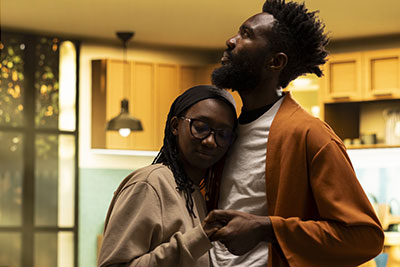
The second woman finds her man at the stove on a Tuesday night. She slides her arms around his waist from behind, rests her chin on his shoulder, and holds her phone up in front of him. On the screen is a cabin hanging off the edge of a cliff, all glass and fog, with a stone fireplace the size of a small car.
“Look,” she says.
He looks.
“Big Sur,” she says. “Fireplace. No neighbors. A door that locks.” She lets that sit for a second, then says it low, her breath against the side of his neck, in a voice that has nothing to do with being a little girl: “Pretty please?”
He doesn’t answer right away. He takes the phone from her and scrolls, slowly, like a man examining a contract he fully intends to sign but would like to enjoy reading first.
“Two nights?” he says.
“Three would be better.”
“Three.” He considers the ceiling. “And what exactly would we do up there for three whole nights?”
She laughs into his shoulder. “I have a list.”
“Is it a long list?”
“It’s extremely long. Parts of it are illustrated.”
He turns the burner down. He turns around. He’s already halfway to the coast in his head: her in front of that fire, the fog pressing against the glass, Saturday morning stretching out with no alarm, no errands, no one knocking. He’s smiling like a man who has just been told a secret about his own life.
“I’m going to need to see this list,” he says.
“You’ll see it when we get there.”
He smiles and hands her back the phone. “I’m taking Friday off.”
Two women. The same fog, the same fire, the same longing to be alone with the men they love. One of them made a very good case. The other made him want to go.
So what happened? Why did the same wish, from two women who love their men equally, land in two entirely different places?
To answer that, we have to go back to what most of us were taught about asking.
How We Were Taught to Ask
Somewhere along the line, a whole generation of women was handed a very particular rulebook for asking.
Know your worth. Never settle. Be reasonable. Make your case. Have your standards ready. And whatever you do, never let him see you want something too much, because wanting too much is how you get hurt.
Some of that advice was born from real heartache, and I understand why it caught on. But look at what it did to the simple act of asking for something you long for. It taught us to lead with the argument instead of the appetite. It taught us that a request is safest when it is defensible, when it comes with evidence, when nobody could possibly accuse us of being needy. A wish learned to wear a blazer. A longing learned to show up with talking points.
And here is the trouble with a very good case. It works on his head, and it misses everything below it. He can agree with every word of it and still feel nothing but a vague sense that he has been reviewed and found wanting. Men can hear that particular note from three rooms away, with the television on, through a closed door. They may not be able to find the ketchup in a refrigerator they have opened every day for eleven years, but that frequency comes through crystal clear.
The first woman never raised her voice. She never threatened anything. She simply protected her heart the way she had been taught to, and in doing so, she hid the one thing that might have made him want to go: how much she wanted to go with him.
The Hidden Tail
Every request has a tail. It’s the part you never say out loud, but he hears it anyway.
The first woman’s tail was quiet, and she would never have spoken it, but it was there: or else this means something about us. If we don’t go, it proves we’ve drifted. If he hesitates, it proves he doesn’t care as much as I do. Her request carried a verdict folded inside it.
The second woman’s tail pointed somewhere else entirely: and then imagine what you and I are going to do with this. And then the fire. And then the fog. And then Saturday morning with nowhere to be and a very long list.
One tail points at a verdict. The other points at a door that locks.
That is really the whole philosophy in one breath. Two women can want exactly the same thing, for exactly the same reasons, and the tail will decide whether he leans toward it or braces against it.
An Invitation Is Not a Technique
Let me be very clear about what I am not saying. I am not saying that if you ask in the right feminine voice, a man will do whatever you want. That would turn pretty please into a technique, and techniques are just pressure wearing lipstick.
A case leaves a man two choices. He can agree, or he can object. If he agrees, he hasn’t really given anything. He has conceded a point. There is no gift in it for him, only a debt paid off, and even his yes walks away feeling a little managed.
An invitation opens a third door. It lets him be generous. When a woman lets him see how much pleasure his yes could create, she isn’t steering him anywhere. She is showing him a place and leaving him free to walk toward it. The second man could have said no. He could have said not this month. What he said instead was, “I’m taking Friday off,” and nobody told him to. He made it his.
That is the difference. A man who is persuaded goes along. A man who is invited comes alive. And a man who comes alive does not feel like he lost an argument. He feels like the luckiest man in the kitchen.
Sweet Is Not Small
Some women hear all this and worry that asking sweetly means asking for less. Keep your requests modest, keep your voice soft, don’t rock the boat.
Absolutely not.
Pretty please is a deliberately sweet phrase. The woman saying it doesn’t have to be. She can be a grown woman with a wicked sense of humor, a very specific agenda, and no intention of apologizing for either. Think of pretty please as the chocolate shell. What’s inside can be pure bourbon.
And yes, pretty please belongs in your sex life. Use it when asking for sex. It’s even better if you’re begging for it. There’s nothing small or powerless about looking at the man you love and letting him see, without a scrap of embarrassment, that you want him that badly. Sometimes the boldest version of pretty please is not sweetness at all. It is appetite without armor.
And sometimes it means wanting to give him pleasure so badly that you’re the one doing the asking: “Can I please suckle Russell the love muscle, baby? Pretty please?”
Sweetness is about how you ask. It has nothing to do with how much. Ask for the cabin on the cliff. Ask for the slow dance in the kitchen. Ask for the whole weekend with the phones off, or for him to plan the anniversary himself, or for the thing you’ve been too shy to say out loud for years. Ask for the big thing and the ridiculous thing and the thing that makes you blush. Just ask for it the way you’d offer someone a present, not the way you’d present a proposal to the board.
The boldest request in the world, delivered with open desire and a grin, is not a burden. It’s an invitation to adventure.
The Courage It Takes
Here is what the rulebook got backwards.
Making a case feels strong, but it is actually the safer move. A good argument is armor. It protects you from looking like you want something too much. It lets you stand behind your reasons and say, in effect, this isn’t about my heart, it’s about what the relationship needs. If he says no, well, he said no to a proposal, not to you.
Pretty please has no armor at all. It shows your wanting in broad daylight. It lets him see that you want him, that you’re hoping, that his answer matters to you. There are no reasons to hide behind. There is only you, wanting something with him, smiling, asking.
That is not weakness. That is nerve. It takes a secure woman to let a man see exactly how much she wants him.
The Other Half
I call it a philosophy for a reason. Asking for what you want with open desire is only the first half of it.
The second half runs in the opposite direction, and it is even more fun. It has to do with what happens when a woman discovers that she wants to give as badly as she wants to receive. That deserves an article of its own. For now, I’ll just say there’s a lot more of it in the book.
Back to the Coast
So picture the second couple a few weeks later. The fog is pressing against the glass. There’s a fire going in that ridiculous stone fireplace. It is Saturday morning, and neither of them has anywhere to be.
She is holding a folded piece of paper. He is trying very hard to read it upside down.
He doesn’t remember being talked into this weekend, because he wasn’t. He remembers the moment at the stove when he started wanting it too. That is the part that made the trip his.
The first couple will probably get their weekend, too. They may have a lovely time. But somewhere on the drive down Highway 1, she’ll catch herself glancing at him, still wondering whether he really wanted to come, or whether he just agreed she had a point.
It was never about the weekend. It was about letting him see the wanting.
Pretty please?
Randi Fredricks, Ph.D.
Chapter Companion Song:
— “More Than a Woman,” The Bee Gees, 1977
This article complements the ideas explored more fully in “The Erotic Power of Enthusiastic Pleading: Why Men Love a Woman Who Begs to Delight Them,” a chapter in Randi Fredricks, Ph.D.’s forthcoming book, Magnificent Men: How Men Are Undervalued and How Worshipping and Being Worshipped Can Bring You The Hot and Holy Love You Desire — a provocative exploration of men’s dignity and worth, the sacred and sensual dimensions of intimacy, and Hot and Holy Love.
Author Bio
Randi Fredricks, Ph.D. is a best-selling author and provocateur whose work explores love, relationships, sexuality, spirituality, and the magnificent complexity of being human. For more than three decades, she has explored what helps people connect more deeply, love more courageously, and create extraordinary relationships. Her writing blends psychology, spirituality, humor, and eroticism, with a particular passion for restoring the dignity and value of men and exploring the possibilities of Hot and Holy Love. At the heart of her work is a simple conviction: all human beings deserve and are capable of extraordinary love — and a beautiful life.