You’re going to need tattoos, red glitter, a mobile DJ, street dancers, and an elephant.
Picture this. You are standing at the edge of a crowd that is — for reasons you don’t yet understand — losing its mind with joy. Drums are pounding a rhythm your chest can feel before your ears catch up. Somewhere a trumpet is blasting to the beat. A throng of people are dancing in the street — not swaying politely, but throwing their whole bodies into it, arms overhead, hips undulating — and every single one of them is dressed like royalty. Glitter and gold thread flashes in the light. Silk moves like it’s alive. Three guys are breakdancing while some dude who looks like your uncle is doing a dance move that will be discussed at family gatherings for the next decade.
And then the crowd parts, and you see why.
There, moving through the street at the unhurried pace of a man who knows the entire evening exists for him, is the groom. He’s dressed in a suit of sorts that looks like it’s made of red glitter. He’s smiling widely, the smile of a man who knows he’s being celebrated by everyone he’s ever loved and they’re all dancing all around him. And because it’s his wedding and he’s the groom, he’s doing all of this from the back of an elephant.
This particular elephant is named Sundar, a Hindi and Sanskrit word that means “beautiful” or “handsome,” which is the perfect way to refer to a creature doing this much emotional labor on your behalf.
Take a moment to let this scene sink in. Compare it to a Western wedding that asks a man to walk in through a side door in a black suit and stand very still. The scene you’ve just witnessed is a Hindu wedding, in its most exuberant form, and it asks the groom to arrive like a conquering hero, borne through a jubilant crowd of his friends and family, drums and music announcing him like he’s the star of the evening — which, for one night, he absolutely is.
You’re going to want to know this man. His name, for our purposes, is Jacob. Somewhere ahead of him, in a room full of women fastening the last pieces of jewelry into place, a woman he has been waiting to marry for what feels like several geological ages is having her own version of this exact feeling — the drums reaching her too, muffled through walls, telling her the whole street already knows what she’s about to do. Neither of them can see the other yet. Both of them can hear the same music.
And what’s about to happen to both of them — the fire, the seven steps, the vows underneath the spectacle — is one of the most emotionally sacred things human beings have ever built out of cloth, smoke, and promises. Keep watching. It gets better from here, and then it gets quieter, and the quiet part is where this whole thing actually comes alive.
This Is More Than a Beautiful Wedding
Before we go further, you should know: there is no single type of “Hindu wedding.” Hinduism spans thousands of years, dozens of languages, and an extraordinary range of regional and community traditions — a Tamil wedding in the south looks and sounds different from a Punjabi wedding in the north, which differs again from a Gujarati, Bengali, or Kashmiri Pandit ceremony. Some communities bring the groom in on horseback, some on elephant, many simply by car or on foot. Some perform four rituals around a fire, others seven. What follows draws on customs that are widely practiced and beautifully documented, but never universal.
Underneath the drumming and the glitter and the borrowed elephant, something remarkably consistent is happening: two people are being formally, publicly, ritually fused into a single unit of meaning. Not merged into sameness — fused the way two flames become one fire while each still burns. The spectacle is not decoration bolted onto a private feeling. The spectacle is the community’s way of saying: this matters enough that we are going to stop everything and make noise about it. Keep that thought. It will matter later, when the noise stops.
The Baraat: Apparently the Groom Is Not Sneaking In
The procession you just watched has a name — the baraat — and it deserves its own paragraph of respect, because nothing in Western wedding culture prepares a man for it. It exalts the groom and demonstrates deep respect for him.
The groom makes his way toward the wedding surrounded by family and friends dancing in the street while live dhol drummers pound out a beat loud enough to announce to several adjoining zip codes that this man is getting married. In a more elaborate display, some couples hire professional street dancers to lead the whole glorious procession. Yes, you heard right, people dancing on their heads, doing somersaults in the air and doing the splits on the ground. There’s usually a mobile DJ rolling right along with them, blasting Bollywood and pop music while friends, cousins, aunties, uncles, and otherwise respectable adults temporarily surrender whatever dignity they arrived with. Meanwhile, somewhere behind all of them, is the groom himself sitting atop the elephant, dressed in a sherwani or similar finery, sometimes crowned with a sehra — a veil of flowers or beads hanging from his turban — because apparently the men also get to be beautiful at their own wedding, a concept Western tradition inexplicably forgot to invent.
And depending on the DJ, things may get considerably less dignified from there. Maybe “Bom Diggy Diggy” comes blasting through the speakers while the groom’s friends dance around him, several of them enthusiastically shaking their money makers as if this were the precise moment they had been saving them for. Think twerking on steroids. The whole thing often becomes so infectious that even onlookers and random passersby join the dancing. Apparently, you don’t actually have to be invited to the wedding. You just need functioning hips.
In parts of Rajasthan and in certain royal or especially grand weddings, the elephant carrying the groom is draped in fabric as ornate as anything the humans are wearing. It’s a spectacle and a hero’s entrance, complete with a fully invested audience whose entire function is to celebrate his wedding day.
If you’re a man reading this and something in your chest just tightened — good. That’s the point. This tradition understands something many modern ceremonies have quietly lost: that a wedding is not only about honoring the bride. The groom is supposed to feel chosen too, celebrated too, seen too, by an entire community willing to dance in the street for him.
And yes —
Sundar gets his moment as well. Before the night is out, the groom who arrived on elephant-back has one final gentlemanly duty: to hand-deliver a proper thank-you: an absurdly generous basket of bananas, mangoes, papayas, pineapples, and figs, handed over with real ceremony. Because a gentleman does not simply use an elephant for the best entrance of his life and then wander off without so much as a thank you. Sundar carried the whole beautiful story on his back.
Sundar eats first.
When the Bride Appears
Then the noise does something unexpected. It doesn’t stop — it changes key.
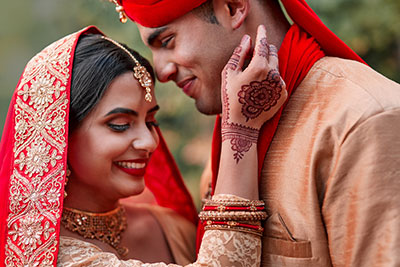
Because somewhere in the middle of all that drumming and color, the bride arrives, and the entire emotional register of the evening narrows, all at once, to her. She is covered head to toe in red glitter, a color considered auspicious in Hindu tradition — the shade varies by region and community — layered in gold jewelry that has, in many families, been worn by mothers and grandmothers before her. Henna tatoos trace up her hands and forearms in patterns some say hide the groom’s initials somewhere in the design, daring him to find them. She may be veiled, partially hidden, deliberately not fully revealed — because this moment isn’t really about the fabric or the gold.
Everyone in that crowd has, at some point in the last several hours, seen her getting ready — the mehndi artist bent over her palm for hours the day before, the aunts arguing cheerfully about which necklace goes on first, the small rehearsed chaos of getting an enormous amount of silk to sit correctly. None of them are the one this moment is actually for.
It’s about the instant the groom actually sees her.
Not glances at her. Sees her — really registers, for the first time that day, the specific woman he is about to spend his life with, dressed as she has never dressed before, surrounded by every person who loves her, walking toward him on purpose. In many traditions this exchange of first glances even has ritual weight of its own — a formal, held moment of looking, sometimes through a cloth or garland held between them before it drops away. It is not an accident that so many cultures build a ceremonial pause around the first real look between two people about to marry. Being seen — fully, deliberately, at your most prepared and most vulnerable — is one of the oldest forms of being chosen there is. Everything else in the ceremony, all the ritual still to come, is really an elaboration on this one wordless fact: I see you, and I am staying.
The Sacred Fire
At the center of the ceremony — often literally, positioned in the middle of the mandap, the decorated four-pillared canopy under which the wedding takes place — burns a fire. This is not ambiance. This is Agni.
In Hindu tradition, Agni is the god of fire, and one of the oldest and most invoked deities in the Vedas — the ancient sacred texts that form the foundation of Hindu religious thought. Agni serves as a kind of divine witness and messenger, the one who carries offerings and vows upward, out of the human world and into the presence of the divine. To marry in front of Agni is not to marry in front of a nice visual effect. It is to marry in front of something understood to be watching, receiving, and sanctifying what is said.
A priest, often chanting in Sanskrit, guides the ceremony and makes offerings into the flames — grains, ghee, sometimes other symbolic substances — as part of a ritual called the homa or havan. The smoke itself is considered a form of blessing, carrying prayer skyward. Around this fire, dressed in silk and marigolds, two people are about to promise each other something in front of their families, their community, and — they believe — something considerably larger than either.
This is where the day changes its own emotional weather again. The exuberance of the baraat, the visual drama of the bride’s arrival — all of it has been leading toward this quieter, more solemn center. Fire has meant covenant in more traditions than this one; there is something in human beings that reaches for flame when we want a promise to actually count, to be sealed by something that cannot be taken back once spoken. What happens next, circling that fire, is the heart of the entire ceremony.
The Seven Steps
The ritual is called Saptapadi — literally, “seven steps” — and it is, in tradition after tradition across the subcontinent, considered the single moment that makes the marriage a marriage. Holding hands, or with their garments ceremonially knotted together, the couple walks seven steps together around the sacred fire, and with each step, speaks or receives a vow.
The specific wording varies significantly by region, language, and community, and no single translation should be treated as definitive. But the vows widely associated with the seven steps tend to move through a recognizable arc: a promise to nourish one another and share sustenance; a promise of strength, to grow in vitality together; a promise of prosperity, to build and share resources honestly; a promise of happiness and mutual respect; a promise regarding children and family, and the wellbeing of future generations; a promise of companionship through every season — the harsh ones as much as the gentle ones; and finally, a promise of eternal friendship and loyalty, the vow that in many traditions is considered the ritual’s completion. In some communities, the marriage is understood to be legally and spiritually sealed the instant the seventh step is taken — which is, when you actually sit with it, a striking thing to build a wedding around. Not a kiss. Not an exchange of rings. Seven steps, taken together, in the same direction, at the same pace.
In some South Indian traditions this same commitment takes a related but distinct form — performed near a homa fire, sometimes counted differently, sometimes folded together with other rice-and-grain rituals specific to that community — a reminder that “the seven steps” is less a single fixed choreography than a shared idea, performed in dozens of regional dialects of ritual. What stays constant, wherever the specifics shift, is the structure itself: a promise, a step, a promise, a step, seven times, until the couple has quite literally walked themselves into a marriage.
It’s worth being precise here, because this is exactly the kind of detail that gets flattened into a greeting-card version of itself: Saptapadi does not literally mean “we will be married for seven lifetimes.” That phrase — saat janam, “seven lifetimes” or “seven births” — is a related but distinct piece of cultural and devotional language, most famously invoked in the belief, popular in Hindu thought and endlessly repeated in Indian film and song, that a husband and wife’s bond can persist across seven cycles of rebirth. The seven steps and the seven lifetimes are two different sevens, related by resonance and poetic echo rather than by direct translation — and conflating them, however tempting, isn’t accurate. What’s true, and arguably more moving than the flattened version, is that this culture has built an entire vocabulary — the seven steps, the seven lifetimes, the sacred witnessing fire — around the idea that a single lifetime might not be a large enough container for what two people intend to give each other.
Sit with that for a second, because it is not a small claim. Most of us structure love, quietly, around its expiration date. We know, somewhere underneath the romance, that this ends — with age, with distance, with death, eventually with the plain fact of being human and finite. The idea of seven lifetimes doesn’t deny that. It answers it. It says: yes, this life will end, and I am telling you now that I would not mind meeting you again in the next one, and the one after that, on purpose, as if we hadn’t already used up an entire lifetime learning each other’s names. What would it mean to love someone so completely that a single lifetime starts to feel like an insult to the scale of the thing? That is not a wedding-day sentiment. That is one of the more staggering claims a human being can make about another human being, and an entire civilization built a wedding ritual sturdy enough to hold it.
Marriage as Something You Keep Choosing
Here is what the seven steps are quietly insisting on, underneath the poetry: none of this is really about the wedding day.
Look again at what the vows are actually about — nourishment, strength, prosperity, family, endurance through every season, lifelong companionship. These are not the concerns of a single spectacular evening. They are the concerns of a Tuesday eleven years from now, when one of them is sick and the other has to decide, again, to show up. They are the concerns of a bad year financially, a difficult in-law, a child who doesn’t sleep, a version of each other that is tired and unglamorous and nothing like the radiant person who circled the fire in silk. The ceremony is spectacular precisely so that the vows underneath it will be memorable enough to survive being unglamorous later.
This is, at bottom, a wedding built by people who understood that love is not a single decision made once, gorgeously, in front of a fire — it is a decision that has to be remade, unglamorously, thousands of times afterward. The wedding day doesn’t finish the story. It hands the couple a vocabulary — nourish, strengthen, provide, respect, protect, endure, remain loyal — and asks them to keep translating it into ordinary Tuesdays for the rest of their lives. The fire goes out that night. The vows are supposed to keep burning.
That’s a very different idea of romance than the one most of us grew up on — the version that treats the wedding as the finish line, the culmination, the moment the story resolves into “happily ever after” and the credits roll. Saptapadi treats the wedding as the starting gun. Everything before it — the drums, the elephant, the silk, even the fire itself — was preparation. The actual marriage is the part nobody photographs: the seven steps repeated, in spirit, every single day that follows, long after the flowers have wilted and the borrowed jewelry has gone back to the aunt who lent it.
And Dear God, Look at Them
Now let’s just stand back for a second and enjoy the view, because Hindu weddings are, without apology, some of the most visually breathtaking human celebrations on earth.
The reds alone deserve their own paragraph: deep, saturated, symbolically loaded shades that read as both passion and auspiciousness, worn by brides across many traditions specifically because the color is considered too vital, too full of life, to be left out of a beginning this important. Gold moves everywhere — in jewelry stacked wrist to elbow, in threadwork so dense the fabric seems to have weight and gravity of its own, in the light off the fire catching every sequin in the room at once. Henna spreads across hands and feet in patterns too intricate to have been rushed, applied over hours the day before, each swirl a small act of anticipation. Flowers are not an accent here; they are architecture — garlands heavy enough to need adjusting, canopies woven from marigolds, petals thrown by the fistful. And through all of it, music never stops insisting that joy is not something you feel quietly.
None of this is excess for its own sake. It is a culture that has decided, correctly, that a beginning this significant deserves to look and sound and smell like one.
Give the Elephant His Fruit
Before we get to the ending, we owe Sundar his encore.
He carried Jacob through a street full of people losing their minds with joy, held perfectly steady under the weight of silk and drumbeats and a groom’s entire nervous system, and did it, by all accounts, like he’d been waiting his whole life to be somebody’s best entrance.
Sundar kept his cool as the groom’s friends twerked and pulsated around him, never flinching.
So somewhere after the ceremony, Jacob brings Sundar a basket — bananas by the bunch, mangoes stacked like they’re competing for a prize, papayas, a small architecture of pineapples, figs tucked in wherever they’ll fit — presented to Sundar with the kind of sincere gratitude usually reserved for the best man. He earned every piece of it.
Maybe One Lifetime Isn’t Enough
Now take all of it away.
Take away the elephant and the drums, the gold thread and the marigolds, the sherwani and the silk, the fruit basket and the crowd still dancing somewhere in the background. Take away the smoke curling up from Agni and the priest’s chanting and the whole magnificent, exhausting, joy-drenched spectacle of the day.
What’s left is two people, standing closer to each other than they’ve ever stood before, having just walked seven steps in the same direction at the same time, having just promised — in front of fire, in front of family, in front of whatever they believe is watching — to nourish, to strengthen, to endure, to remain. Two people who have, in their own language and their own tradition, reached for the largest unit of time their culture has words for — not a year, not a decade, not even a single life — and offered it to each other anyway, fully aware they might be asking for more than any one lifetime can hold.
Because maybe that’s the real declaration hiding inside all that color and fire and noise. Not I want to spend my life with you — plenty of people manage to say that and mean it only loosely. The rarer thing, the thing worth building an entire wedding tradition around, is the quieter and far more staggering admission underneath it: that a single lifetime with this person, however long and however good, might simply not be enough. That love this large needs somewhere else to go when this life runs out.
Jacob doesn’t know yet what any of the coming decades will actually ask of him. Neither does she. Nobody circling a fire in silk ever does. But for one evening, with an elephant somewhere outside eating his well-earned fruit, two people stood close enough to share the same breath and said, in effect: this life won’t be enough time. I’d like the next one too. Seven steps. Seven lifetimes, if the poetry is to be believed. One bond, apparently, that nobody involved is prepared to consider finished.
The Following Year
Almost exactly one year later, Jacob and his wife drive out to the farm where Sundar lives.
There are no drums this time. No gold thread catching the light. No friends dancing in the street, no sacred fire, no groom sitting high above a jubilant crowd while people enthusiastically shake their assets.
Just the two of them.
And an absolutely ridiculous basket of fruit.
Jacob carries it himself — bananas, mangoes, papayas, pineapples, figs — because some traditions are worth inventing and then refusing to abandon.
They are still some distance away when Sundar sees them.
At first, nothing happens.
Then Jacob steps closer.
Sundar looks at him.
And something registers.
Maybe it’s his face. Maybe his voice. Maybe somewhere in that extraordinary elephant memory is a man in silk sitting on his back while drums thundered and half the people surrounding them temporarily surrendered their dignity. Or maybe it’s the mangoes.
Whatever it is, Sundar remembers.
He lifts his trunk and trumpets.
Jacob stops dead.
His wife looks at him.
And there it is again — that enormous, ridiculous grin. The same grin he wore a year earlier when he rode into his wedding on the back of an elephant while everyone he loved danced around him.
“He fucking remembers me!”
Of course he does.
Jacob walks the rest of the way toward him carrying the basket, and Sundar reaches his trunk toward the man he once carried into the beginning of his marriage.
The fruit is handed over.
The mangoes disappear first.
And standing there beside the elephant who was there when their marriage began, husband and wife discover something lovely about anniversaries:
Sometimes you return to the place where a story started simply to say, We’re still here.
Sundar trumpets again.
And because he is a gentleman, Jacob has brought extra mangoes.
Randi Fredricks, Ph.D.
Chapter Companion Song Recommendation:
— “Bom Diggy Diggy,” Zack Knight, Jasmin Walia & Kumaar, 2018
This article is an excerpt from Randi Fredricks, Ph.D.’s forthcoming book Magnificent Men: How Men Are Undervalued and How Worshipping and Being Worshipped Can Bring You The Hot and Holy Love You Desire, exploring the restoration of men’s dignity and worth, the sacred and sensual dimensions of intimacy, and hot and holy love.
Author Bio
Randi Fredricks, Ph.D. is a best-selling author, psychotherapist, and leading expert in counseling, communication, and human connection. Her first published study, released in 1993, explored the impact of family dysfunction on intimacy and communication in adult relationships. For more than three decades, she has developed innovative therapeutic models to help individuals and couples create deeper connection, emotional resilience, and extraordinary relationships. Her work explores the intersection of psychology, spirituality, humor, eroticism, and human magnificence, helping people live more fully, love more deeply, and embrace the extraordinary possibilities of a beautiful life.