Your worth was never taken. It was merely suppressed. It’s time to reclaim it.
Francis Hughes, front and center. Terence MacSwiney, top row, second from right. Mural: Who Can Endure the Most (2011) Artist: Seany McVeigh Location: Northumberland Street, West Belfast, Northern Ireland Photograph © RM Ireland / Alamy Stock Photo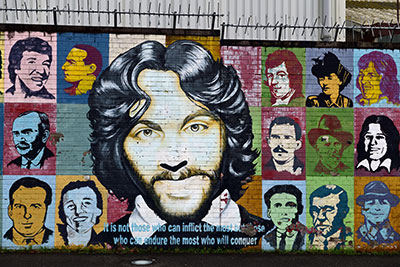
The Magnificent Protocol is a transformational exercise designed to help people recognize their own magnificence, reclaim their sense of worth, and become capable of receiving and giving extraordinary love.
The essential transformation is this: A person moves from recognizing magnificence in others to recognizing that same capacity for magnificence within themselves.
Its ultimate purpose is to strengthen someone’s ability to:
- Worship their partner wholeheartedly.
- Allow themselves to be fully worshipped.
- Abandon themselves to the ecstasy of deep love.
Let’s Begin
Most men who want to be loved know, at some level, that they want it. What they struggle to do — what years of being valued for their productivity, their strength, their capacity to provide and endure without complaint have made genuinely difficult — is believe that they deserve it simply for being who they are. Not the conditional approval that arrives when they perform correctly. Not the respect that comes when they succeed or sacrifice or hold everything together without breaking. But the full, reverential, uncompromising devotion that a man can receive and surrender to without having first earned it moment by moment. The idea of being truly cherished — not for what he does but for what he is — is, for many men, almost impossible to hold without immediately deflecting it. This chapter is for those men. It’s an invitation back into a worth that was always theirs and that the world was never supposed to take permanently away. The goal of this exercise is to reclaim what was never truly lost.
What I’m about to tell you may seem bold.
I’m about to tell you about three men with wills of pure steel and hearts of gold. Then I’m going to ask you to believe that somewhere deep inside you that same greatness exists. And then I’m going to show you how to prove it to yourself.
The stories of these men reveal what dignity looks like when a human being is stripped of everything except conviction, sacrifice, and unyielding will. The sacred ache of their hunger became a testimony to the power that can emerge when a man refuses to betray what he believes in and those he loves.
As you read about the physical reality of what these men endured, some part of you will feel it in your own marrow.
By the end of this chapter — when it’s time to do the exercise — your mind will have quieted enough for us to speak directly to your worth.
It’s my hope that the words in this chapter challenge you, strengthen you, and awaken something that may have been sleeping inside you for a very long time.
What I am about to show you is a lineage of magnificence that you are invited to join. Welcome.
That invitation may land strangely — or not land at all, at least not at first. Most men were never taught to think of themselves as belonging to any lineage of magnificence. They were taught to be useful. To be strong. To endure, to solve, to show up without requiring too much in return. The idea that they might be worthy of reverence — not because of what they have accomplished or survived, but simply because of what they fundamentally are — can feel almost foreign. That discomfort is worth noticing. It is not evidence that the invitation is wrong. It is evidence of exactly how much ground there is to recover. The men you are about to meet did not discover their dignity by becoming perfect or by achieving the right things in the right order. They discovered it in conditions of extreme deprivation — stripped of comfort, freedom, safety, and everything the world ordinarily uses to measure a man’s worth — and found that something remained. Something that could not be confiscated nor tamed. Something that had been there all along, quietly waiting to be recognized.
The following are the true stories of three men, each of whom used fasting as a moral, spiritual, and philosophical discipline: Terence MacSwiney, Charles Liteky, and Francis Hughes.
Fasting is often misunderstood. Most people think of it only in terms of food, deprivation, weight loss, religion, or self-control. But throughout human history, fasting has also been something far more dangerous and transformative. It has been used as prayer. As purification. As protest. As resistance. As a way for human beings to confront fear, sharpen conviction, and discover what remains when comfort is stripped away.
A genuine fast has a way of exposing the architecture of a person. It reveals where conviction ends and performance begins. It confronts the body with discomfort and asks a terrifyingly simple question: What matters enough to suffer for?
These men answered that question differently, in different eras, under radically different conditions. One risked his freedom and very life confronting an empire, using hunger as a weapon of conscience when other forms of protest had been stripped away. One returned the nation’s highest military honor and went without food for forty-seven days to protest the policies of the country he had once risked his life for. And one endured imprisonment, devastating injuries, and extraordinary physical suffering rather than abandon his values and beliefs.
Their cultures were different. Their histories were different. Their very lives were different. But all three men understood something that modern life works very hard to make us forget: Human dignity is not merely an idea. It is something a person must decide whether or not they are willing to embody.
That is why these men were chosen. Because restoring dignity restores our belief in our ability to give and receive love.
Not because they were perfect. Not because every action they took was beyond criticism. And not because suffering itself is noble. They were chosen because each of them, in his own way, reached a point where preserving inner integrity became more important than physical comfort, public approval, or even survival itself.
If you’ve come this far in this book, then you know I believe a man can be magnificent without being perfect. The three men I chose for this chapter are all highly controversial historical figures and I do not pretend otherwise. I do not have to agree with every choice a man has made to recognize his courage, devotion, humanity, or the love that lived within him. If magnificence required moral perfection, I’m not sure there would be any magnificent men at all.
Most people never encounter that part of themselves. Instead, they spend their lives adapting, negotiating, shrinking, performing, apologizing, abandoning their instincts, tolerating half-hearted love, and slowly forgetting the sound of their own deepest convictions. We live in a world that constantly pressures human beings to betray themselves in exchange for safety, acceptance, convenience, or numbness.
This chapter is an invitation to interrupt that process.
Not through ideology.
And not through punishment.
But through encounter.
As you move through these stories, I want you to pay attention not only to the minds of these men, but to their bodies. To the loneliness. To the fear. To the determination. To the ache. To the moments where the human body itself became the final instrument through which conscience could still speak.
Because something extraordinary happens when a person willingly enters discomfort in service of meaning. The noise begins to fall away. Performance falls away. Pretending falls away. And beneath all of it, something sacred and more honest begins to emerge.
That is the threshold you are about to approach. Not merely an intellectual understanding of dignity. But an embodied encounter with it.
Hunger Striking: What It Is and Why I’m Using It
All of the men discussed in this exercise participated in hunger strikes.
A hunger strike is a form of nonviolent protest in which a person voluntarily refuses food in order to draw attention to a cause, principle, or injustice they believe is important. They do it for the people they love. In their own ways, each of these individuals stood in the gap between injustice and fairness, accepting personal suffering in service of others. Throughout history, hunger strikes have been used by people from many cultures, political movements, and religious traditions.
The purpose of this exercise is not to encourage hunger striking, nor is it intended to compare a skipped meal to the profound sacrifices made by the men described in these pages. I’m featuring these men because they demonstrated unusual courage, conviction, devotion, and willingness to endure discomfort for something they believed mattered. Each, in their own way, embodied magnificence.
The purpose of this exercise actually has nothing to do with hunger striking. The purpose is much more personal. It has to do with helping you to recognize the magnificence and magnitude of your dignity and worth.
Once you are immersed in the exercise, I am going to ask you to recognize the part of yourself that is as great as each of them. And believe that you are just as worthy of deep, devoted love as each of these men were.
Terence MacSwiney: The Magnificence of a Conviction
The Man
Terence MacSwiney was an Irish playwright, teacher, and politician during the Irish War of Independence (1919–1921), when the Irish people were fighting to end British rule and establish an independent Ireland. Arrested by British authorities for his role in the independence movement, he began a hunger strike that held the attention of the entire world. He left behind a wife, a two-year-old daughter, and a legacy that endures to this day.
His death in London’s Brixton Prison after seventy-four days without food became a defining moment in the struggle for Irish independence. It turned a local conflict into an international story. But as you will discover, his magnificence was never only about politics. He was a man willing to give everything for the people and the country he loved.
His Story
Terence James MacSwiney was born at 23 North Main Street in Cork City on March 28, 1879, one of eight children. His father, a businessman whose tobacco factory had failed, emigrated to Australia when Terence was six and never came home. His mother, an English-born Catholic, was deeply religious and a fervent Irish nationalist, and she raised her children in both convictions. The abandonment by his father, the hardship that followed, the responsibility that fell early — these are the conditions that formed a man who would spend his life thinking seriously about what human beings owe each other and what they are capable of enduring.
At fifteen he left school to help support the family, taking a job as an accounting clerk. His hunger for learning never left him. While working full time, he studied at night and earned his degree from the Royal University in 1907. In 1901 he helped found the Celtic Literary Society, and in 1908 he co-founded the Cork Dramatic Society. He wrote plays and poetry, he taught, and he wrote essays on national identity, character, and the moral foundations of freedom. Before he became a symbol, he was a writer and a teacher — a man who believed that stories and ideas shape nations.
As a leader of the Irish Volunteers in Cork, he was arrested in the roundup after the 1916 Easter Rising and held until that December. In February 1917 he was arrested again and, without charge or trial, deported to England under wartime emergency powers. He was confined first to Shrewsbury and then to the small town of Bromyard in Herefordshire. It was there, in June 1917, that he married Muriel Murphy in the town’s small Catholic church.
Muriel was the daughter of one of the wealthiest families in Cork, the Murphys of the brewery and distillery, and she married him against her family’s wishes. She could have had any comfortable life she wanted. She chose a poet under police watch in an English market town.
Within weeks the restrictions were lifted, and he brought his bride home to Cork. He spent his last three years building the independence movement there, in and out of prison. He was arrested in November 1917 for wearing a Volunteer uniform and drilling men, and again in 1918.
His daughter, Máire, was born in Cork on June 23, 1918, while Terence was being held in Crumlin Road Gaol in Belfast. He met her for the first time inside that prison, when she was three months old. Still behind bars that December, he was elected Sinn Féin MP for Mid Cork. Like the other Sinn Féin winners, he refused to take his seat at Westminster and joined the breakaway Irish parliament, Dáil Éireann, instead. After his release, he took command of the Cork No. 1 Brigade of the IRA as the War of Independence got under way.
In March 1920, his close friend Tomás Mac Curtain, the Lord Mayor of Cork, was shot dead in his own home by men widely believed to be police. Terence was chosen to take his place. In his inaugural speech, he said that victory would come not to those who could inflict the most, but to those who could endure the most.
Five months later, he would be asked to prove it.
The Playwright Who Believed in Ideas
To understand what Terence did at the end of his life, you have to understand what he believed in the middle of it. He was, at his core, a writer, a man of the imagination — someone who understood that the interior life of a people, the stories they tell themselves about who they are and what they are capable of, determines what they will actually do in the world.
His play The Revolutionist (1914) explored conscience, loyalty, and sacrifice. Long before his hunger strike made him famous, Terence was fascinated by the question at the center of every great drama: What does a person do when conscience demands a price? His plays kept returning to the collision between comfort and conviction, between safety and duty, between what is easy and what is right. Years before history handed him that question in his own life, he had already been asking it on the page.
His essays, published after his death as Principles of Freedom (1921), argued that genuine freedom is not merely a political condition but a moral and spiritual one — that a people who have not developed their own inner resources cannot be free, whatever flag flies over them. “No physical victory can compensate for spiritual surrender,” he wrote.
This was not abstraction for Terence. It was a lived conviction. His literary sensibility let him see beyond the immediate moment and understand that what he did could reverberate long after he was gone.
Husband and Father
By 1920, Terence’s ideals were no longer abstract. He was married to Muriel, whom he deeply loved, and he was the father of a little girl. Their marriage was built around a shared love of literature, ideas, and Ireland. Through his imprisonments and their long separations, he wrote to her about books, art, and the future they hoped to build together. Even as political events closed in around him, he never stopped being a husband who delighted in sharing his inner world with the woman he loved. This matters, because it is easy to minimize a sacrifice when we forget what someone had to lose.
Terence did not walk into prison as a solitary revolutionary detached from human attachments. He walked in as a husband and a father. He knew exactly who would bear the cost of his decisions. He knew his wife would suffer. He knew his daughter might grow up without him. The choice before him was not between life and death. It was between competing loyalties: loyalty to his family and loyalty to his conscience.
Muriel felt that collision too. She stood by him every day of his fast. She also quietly pleaded with republican leaders to call him off it. Both of those things were love.
What makes his story remarkable is not that he failed to understand the cost. It is that he understood it completely.
Lord Mayor, Prisoner, Hunger Striker
On August 12, 1920, British forces raided Cork City Hall and arrested the Lord Mayor of Cork, charging him with possession of a police cipher and what they called seditious documents.
That same day, in Cork Gaol, he refused food. More than sixty republican prisoners there had begun a hunger strike the day before, and Terence joined them. Four days later he was tried by a military court and sentenced to two years in prison. He told the tribunal that he would put his own limit on any sentence they imposed: “I shall be free, alive or dead, within a month.”
He was wrong about the month. He was right about the freedom.
He was shipped to Brixton Prison in London. Back in Cork, most of the original strikers were released or deported within the week, leaving eleven men still refusing food in Cork Gaol: Peter and John Crowley, Christopher Upton, Michael O’Reilly, Joseph Kenny, Seán Hennessy, Michael Burke, John Power, Thomas O’Donovan, Michael Fitzgerald, and Joseph Murphy. Two of them would not survive. Michael Fitzgerald died on October 17, after sixty-seven days. Joseph Murphy died on October 25, after seventy-six days. The nine survivors held on for three more weeks, until Arthur Griffith persuaded them to stop on November 12, after ninety-four days without food. None of them escaped unscathed. Their health was permanently damaged, and many of them died young.
In Brixton, Terence’s body began to do what a starving body does. The flesh fell away week by week. Bishops and an archbishop came to his cell and left describing a man utterly prostrate. Newspapers across Europe, the United States, India, and beyond carried daily reports of his condition, and crowds gathered outside the prison gates. People throughout the world petitioned for his release. The British government refused, declaring that whatever happened, he alone would be responsible.
In the final weeks he drifted in and out of delirium. Muriel later remembered him turning to her and saying, “Muriel, you have always stuck by me.” Around the seventieth day, prison doctors attempted to force-feed him. Soon after, he slipped into a coma. Days before the end, his sister Mary smuggled in a sculptor, posing as a relative come to say goodbye, who took measurements of his face. The life mask made from them still exists. There is a small smile on his lips.
Terence MacSwiney died on October 25, 1920, with Mary at his side. He had gone seventy-four days without food.
The world answered. In the United States, longshoremen pledged to refuse to load British ships until British forces left Ireland, and four South American nations appealed to Pope Benedict XV to intervene. Thirty thousand people filed past his body at St George’s Cathedral in London. His funeral in Cork drew enormous crowds.
When Terence died, the cost was no longer theoretical. Anticipating that he might not survive, he had already named his sister Mary as joint guardian of little Máire. Within weeks of his death, Muriel crossed the Atlantic to testify about conditions in Ireland and to tour America for the cause, and two-year-old Máire was left for eighteen months in the care of a family friend. She would spend most of her childhood far from Ireland and from the city where her father was buried, until, at fourteen, she came home to Cork to live with her aunt Mary. The sacrifice that inspired millions also scattered the people who loved him most. That is part of the story too.
Mary carried that sacrifice for the rest of her life. She had watched her beloved brother die rather than abandon his conscience, and where many would have been broken, her commitment only deepened. When Ireland fell into civil war over the treaty with Britain, the new Irish government imprisoned her twice, and twice she went on hunger strike — twenty-four days in Mountjoy Prison in 1922, and three more weeks in Kilmainham Gaol in 1923. Both times she was released rather than risk the outrage that would follow the death of another MacSwiney. Terence’s courage did not end with his own death. It lived on in the resolve of his sister and the many others who refused to let his sacrifice be forgotten.
Terence MacSwiney: The Man Who Influenced Generations
His story crossed oceans. In India, Jawaharlal Nehru drew on Terence’s example and his writings, and Principles of Freedom was translated into Indian languages. Gandhi held him in deep respect, even though he could not bring himself to endorse a fast unto death. The young revolutionary Bhagat Singh admired him and invoked his example as he faced his own execution. Ho Chi Minh is said to have remarked of him, “A nation that has such citizens will never surrender.”
These were among the defining figures of the twentieth century. Each was touched, in some measure, by the example of a poet from Cork who refused to eat.
Terence’s Influence on the H-Block Hunger Strikers of Long Kesh
Sixty years after Terence’s death, the ten men who died on hunger strike in the H-Blocks of Long Kesh in 1981 understood themselves as standing in a tradition he had helped establish. Courage, it turns out, travels across generations. Bobby Sands himself named Terence as an influence.
The ten men who died were Bobby Sands, Francis Hughes, Raymond McCreesh, Patsy O’Hara, Joe McDonnell, Martin Hurson, Kevin Lynch, Kieran Doherty, Thomas McElwee, and Mickey Devine. Each chose to hunger strike as an expression of devotion to the people he loved and the principles he believed were worth defending.
Bobby Sands was the first to die, on the sixty-sixth day of his fast. By then, a man who had died in Brixton in 1920 had long since become part of the living memory of Irish republicanism — proof that endurance itself could be a form of power.
What Made Terence Different
He was not a man of hatred. His writings are remarkably free of bitterness toward the English people; he distinguished carefully between a political system he opposed and the human beings within it. “Our enemies are brothers from whom we are estranged,” he wrote. He was a man of faith — deeply Catholic, shaped by the conviction that human dignity is not merely political but sacred.
He was a husband and father who left behind a two-year-old daughter and a wife who carried his story across America. The personal cost of his choices was enormous and entirely visible to him. He made them anyway.
His most frequently quoted principle — “It is not those who can inflict the most, but those who can suffer the most who will conquer” — is not a call to passivity. It is a reorientation of power. It insists that the person who can endure for something true wields a different and deeper force than the person who can cause pain.
Why Terence Still Matters
What do we value enough to sacrifice for? Can one person’s courage reach people they will never meet?
In Terence’s case, the answer is yes. Nehru, Bhagat Singh, Ho Chi Minh, Bobby Sands — none of them ever met Terence MacSwiney. All of them carried something of him.
Terence’s story is part of this exercise not because he suffered, but because of what his suffering expressed. Courage. Faith. Love of family. A willingness to see beyond himself. An understanding that the measure of a life is not only what it costs, but what it gives to those who come after. The playwright who spent his life exploring the power of ideas became one of the most powerful ideas of all.
The qualities that made Terence magnificent were never reserved for extraordinary people alone. Conscience. Devotion. Love. They are part of the human inheritance. This exercise simply asks you to believe that those same qualities — and the same worthiness of profound love — exist within you too.
On the understanding that we will be heroes tomorrow, we evade being men to-day.
– Terence MacSwiney
Charles Liteky: The Magnificence of Courage
The Man:
Charles “Charlie” Liteky was a Catholic priest and Army chaplain who went to Vietnam carrying no weapon at all. He came home carrying the nation’s highest military honor: the Medal of Honor. Nearly twenty years later, he became the only known recipient in American history to renounce that honor. Just weeks later, he began a hunger strike on the steps of the U.S. Capitol to protest the war policies of the government that had once decorated him for courage.
To some, those two acts looked like a contradiction: the hero and the protester, the decorated chaplain and the man starving himself in front of Congress. Charlie never saw it that way. He said he gave the medal back “for the same basic reason I received it — trying to save lives.” He spent his whole life running toward people in danger. Only the danger changed. First it was a machine gun in a Vietnamese jungle. Later it was a policy written in Washington. Through all of it he remained a man who could not look away from suffering, and who never believed his own safety was worth more than someone else’s life.
His Story:
Charlie was born in Washington, D.C., on February 14, 1931 — Valentine’s Day, fittingly, for a man whose life would be ruled by love. His father was a career Navy man the family called “the Chief,” a World War II veteran who served thirty-three years in uniform. The Navy kept the family moving, from base to base and town to town, and Charlie grew up the way military children do: always the new kid, always learning to fit in quickly, always absorbing the unspoken creed of a household where duty came first.
He finished high school in Jacksonville, Florida, where he was the quarterback of the football team — the boy the others looked to when the play broke down. He spent two years in college. Then he surprised the people who thought they knew where his life was headed and transferred to a small seminary in Alabama run by the Missionary Servants of the Most Holy Trinity, a Catholic order devoted to serving the poor and the forgotten. In 1960 he was ordained a priest and took the religious name Angelo. For the next six years he served parishes in New York, Virginia, and elsewhere.
In 1966, he heard the Army was desperately short of Catholic chaplains. He was thirty-five years old, well past the age when most men go to war, and nobody would have faulted him for staying home. He volunteered anyway, believing, in his words, that he “was doing God’s work.” He would later describe the man he was then, honestly and without flattery, as “a clerical hawk.” He believed in the war. He believed in his country. And he went where the young men were dying.
On December 6, 1967, Chaplain (Captain) Liteky was moving with Company A of the 199th Light Infantry Brigade near Phuoc Lac in South Vietnam when they walked into a battalion-sized ambush. The men hit the ground. Charlie did not stay there. He saw two wounded soldiers lying fifteen meters from an enemy machine gun and moved toward them anyway, placing his own body between the gun and the men on the ground. When the fire slackened for a moment, he dragged them both to the landing zone.
He did not stop. Through the rest of that day he ran upright through open fire — no rifle, no cover, a wounded man’s weight in his arms more often than not — pulling soldier after soldier back to the landing zone and administering last rites to the ones he couldn’t save in time. When Charlie found a man too heavy to carry, tangled in thorned brush, he rolled the man onto his own chest and pushed them both backward through the dirt using his elbows and heels, inch by inch, until they reached safety. He was shot in the neck and the foot during the fighting. He kept going anyway. As the helicopters came in, he stood up in the open and directed them to the wounded. By the time the battle ended, he had personally carried more than twenty wounded men to that landing zone. It was the first combat he had ever seen.
In November 1968, President Lyndon Johnson hung the Medal of Honor around his neck, the highest decoration the United States gives for valor in combat. “I’d rather have one of these babies than be president,” Johnson told him. Charlie was one of only three Army chaplains to receive it for actions in Vietnam — the other two, posthumously.
That should have been the whole story. A humble man of God who ran into gunfire unarmed because that was simply what love required of him that day. But Charlie’s conscience wasn’t finished with him yet.
He served a second tour in Vietnam and left the Army in 1971 with, as he later put it, “my humanity severely damaged.” In 1975 he left the priesthood, too. For a while he lived quietly — counseling veterans, working at a halfway house, making candles, living in a small cabin on a Florida island. In 1983 he married Judy Balch, a former nun and a math teacher with a fierce heart for the poor. It was Judy who opened his eyes to the refugees streaming out of Central America, and to what his own government was doing there: arming and training forces accused of massacring civilians in Nicaragua and El Salvador, while a sitting president compared them to America’s Founding Fathers. Charlie traveled there himself to see it firsthand. What he found broke something open in him. “I was ashamed of my country,” he said afterward. “And I was ashamed I’d participated in the same thing in Vietnam.”
On July 29, 1986, Charlie did something no other Medal of Honor recipient has ever done, before or since. He walked to the Vietnam Veterans Memorial in Washington, D.C., placed his medal in an envelope addressed to President Ronald Reagan, and left it at the base of the wall, among the names of the dead. He also gave up the lifetime pension that came with the medal.
In September 1986, Charlie and three fellow veterans — George Mizo, S. Brian Willson, and Duncan Murphy — sat down on the steps of the U.S. Capitol and began a hunger strike, taking nothing but water. They called it the Veterans Fast for Life. They wanted to force the nation to look at what was being done in its name in Central America, and at the congressional funding that kept the Contras armed. Day after day, Charlie, now in his mid-fifties, sat in the open and let his body waste away in full view of the lawmakers walking past. After forty-seven days, with one of the four men close to death, they ended the fast.
Think of what these renunciations actually cost him: first his medal, and then food. The medal was not a trophy — it was proof, worn by a man not given to boasting, that he had once run through gunfire to save more than twenty lives. To give it back was to say, in the plainest language he had, that the same conviction which sent him unarmed toward machine guns in 1967 now demanded he starve his own body on the steps of the U.S. Capitol in 1986. He never described the two acts as opposites. He described them as the same man, doing the same thing, in two different uniforms: showing up, at cost to himself, for people who could not save themselves.
Charlie kept showing up for the rest of his life. In 1990 he fasted again, for thirty-five days, outside the Army’s School of the Americas at Fort Benning, Georgia, where Latin American soldiers were trained. His protests there sent him to federal prison twice — once alongside his brother Patrick. During his last stretch, he refused to work in a prison industry he considered immoral and spent his final seventy days in solitary confinement. He was then nearly seventy years old. In 2003 he traveled to Baghdad to stand against the coming war in Iraq, and he kept marching with fellow veterans into his eighties. Judy, his partner in all of it, died in August 2016. Charlie followed her five months later. He died in San Francisco on January 20, 2017, at eighty-five, the only man in the medal’s history to have returned it.
There is a particular kind of magnificence in a man who has already proven his courage beyond any question and chooses to risk being called a traitor rather than stay silent in the face of injustice.
Charlie didn’t hunger-strike because he doubted his country. He hunger-struck because he had loved it enough, once, to nearly die running through gunfire for the men beside him — and he went on loving it in that same fierce way, sitting hungry on the steps of his nation’s Capitol.
The Medal of Honor awarded to Charlie Liteky is now held by the National Museum of American History, a testament both to his extraordinary heroism and to the conscience that eventually compelled him to give it back.
“If there is an enemy here, it’s violence. We need to protest and boycott violence because we eat, drink and sleep it in our country; we are entertained by it. If we don’t stop, we’re just going to join in an unending cycle of violence, like an escalator that keeps going up and up and up.”
— Charlie Liteky
Francis Hughes: The Magnificence of a Fearless Heart
The Man
Francis Hughes was a young Irish rebel who joined the Irish Republican Army (IRA) at seventeen during the Troubles (late 1960s–1998), an asymmetric war in Northern Ireland over whether the region should remain part of the United Kingdom or become part of a united Ireland. The conflict divided communities, claimed thousands of lives, and shaped nearly every aspect of daily life for the people who lived there. It was in this world that Francis came of age.
At nineteen, believing British forces were about to arrest him, he went on the run. He remained at large for three years before being captured by British Forces. Three years later, he became the second of ten Irish republican prisoners to die during the 1981 hunger strike in Long Kesh prison. He died on May 12, 1981, after fifty-nine days without food, at just twenty-five years old, becoming one of the most recognizable figures of the conflict. Yet before Francis Hughes became a symbol of history, he was a son, a brother, a loyal friend, and a young man whose warmth, mischievous humor, and generous spirit left an unforgettable impression on nearly everyone who knew him.
His Story
Francis Joseph Sean Hughes — Frank to the people who knew him — was born on February 28, 1956, the youngest of ten children, into a staunchly republican farming family rooted for generations in the townland of Tamlaghtduff in County Derry. His father, a small cattle farmer named Patrick Joseph, had himself been an IRA volunteer back in the 1920s, and his uncle had smuggled arms. Republican conviction ran deep in the family long before Frank ever chose that path. Because of that history, the Hughes family was targeted by British forces when internment was introduced in 1971, and Frank’s brother Oliver was interned for eight months without ever facing a trial. That conviction, not bitterness, is what carried Frank into the republican movement — first through a small independent unit he helped organize after growing disillusioned with a ceasefire he believed had betrayed the cause, and then, by the end of 1973, formally into the ranks of the IRA.
But before that Frank’s life was remarkably normal. His father and his mother, Margaret, raised all ten of their children just a quarter mile down the road from their cousins, the McElwees. One of them, Frank’s cousin Thomas, would later stand beside Frank in Long Kesh and eventually undertake a hunger strike and die himself.
Frank’s father remembered him as a boy who was always whistling, joking, and singing, with a restless, sunny energy that never once left him, not on the run, not under interrogation, not in a prison cell. It became, in time, one of his sharpest weapons: he could walk into a freezing safe house full of frightened men and leave them laughing within minutes. He carried people’s morale the way other men carry a compass — constantly, instinctively, without ever being asked. His mother called him a good tractor man; his neighbors simply called him the life of Tamlaghtduff.
As a boy he was a solidly good student, best at history and woodwork, though never much for organized sport. What he loved was being outdoors—tearing around on bikes and, later, cars, and always in motion, always restless in the best possible way. He also had a generous heart and was always willing to help people who needed him. He loved to dance, and he was a regular at the local ceilidhs, even in his most hunted years when he was the most wanted man in Northern Ireland, when every dance floor was its own small act of defiance against an army actively hunting him down.
Bloody Sunday in Derry
Frank was fifteen years old when Bloody Sunday unfolded in Derry on January 30, 1972—British paratroopers opened fire on unarmed civil rights marchers, killing fourteen people, just a short drive from his home. The massacre sent a wave of outrage through nationalist communities across Northern Ireland, hardening resolve and fueling a surge in support for the IRA, particularly among young people who had grown up watching their communities treated with suspicion. It also shattered the hope that peaceful protest alone might bring about change. It was into this atmosphere of grief, anger, and deepening division that Frank, still a teenager, was coming of age.
He left school at sixteen to apprentice as a painter working under his brother-in-law, and the trade stuck with him in the strangest way: even while living on the run, hopping between safe houses under constant threat of capture, he would often do a bit of painting or wallpapering for whoever was putting him up, because sitting idle was never in his nature. Legend has it that once, with ‘wanted’ posters of his own face plastered across the county, he was calmly painting a window frame out front of a house when two jeeploads of British soldiers rolled slowly past. While everyone else inside froze in terror, Frank just waved, smiled, and kept right on painting.
That fearlessness had a harder edge underneath the humor, and it was forged early. At seventeen, walking home from a dance with a friend, he was pulled over by British soldiers and beaten so badly he was bedridden for days afterward. The next morning when Frank could not get out of bed his father urged him to file a complaint with the police, but Francis replied, “There’s no point in it. I’ll get those boys in my own way.” That was not a promise built on hatred; those who knew him best insisted that his beliefs were never rooted in revenge. It was a clear-eyed conviction, forged in his own bruised and battered body, that his country and his community deserved something far better than this. Northern Ireland in those years was a place of army patrols, curfews, and helicopters overhead at night, and Frank grew into manhood inside all of it, watching people he loved treated as suspects in their own townland.
His Decision to Leave Home and Go on the Run
Because of his family’s years of involvement in the IRA, Frank’s home, the Hughes family farm, was raided regularly by the British Forces. Believing that his arrest was imminent, Frank decided to go on the run as an active IRA member in 1975.
What followed were years that turned Frank into a living legend across South Derry, Tyrone, and Antrim counties. From late 1975 until 1978, he lived entirely on the move. He frequently walked up to 20 miles a night, slept in ditches or fields during the day, and habitually wore full military combat uniforms to blend into the rural terrain. Operating in South Derry meant he was fighting shoulder-to-shoulder with people he had known his entire life—neighbors, family, and friends who shared his background and culture. Protecting and standing up for his home region was at the core of his commitment.
The Gun Battle That Made Him Northern Ireland’s Most Wanted Man
By 1977, Frank had already been living on the run for nearly two years, but an encounter near Moneymore that spring dramatically intensified the effort to capture him. On April 8, 1977, Frank was traveling with fellow IRA members Dominic McGlinchey and Ian Milne when an RUC patrol, Northern Ireland’s police force, signaled their car to stop. The three men attempted to escape by making a U-turn, but their car ended up in a ditch. They abandoned the vehicle and opened fire on the approaching patrol, killing two RUC officers and wounding another. A second RUC patrol also came under fire as the three men fled, but despite a search involving both the RUC and the British Army, Frank, McGlinchey, and Milne escaped.
The Moneymore gun battle marked a turning point in Frank’s years as a fugitive. After the shootings, the RUC took the extraordinary step of publicly naming him the most wanted man in Northern Ireland and circulated wanted posters bearing photographs of Frank, McGlinchey, and Milne. Frank had been hiding from British forces long before Moneymore, but now the hunt for him entered another league entirely. The young man who had already spent years sleeping in fields, moving between safe houses, and slipping through checkpoints had become the most intensely sought republican fugitive in Northern Ireland.
Even under that pressure, Frank remained operationally active. He took control of a highly active South Derry IRA unit and continued participating in the armed campaign while evading capture. The wanted posters made his face recognizable across the region, yet he remained at large for almost another year.
His sheer audacity was as legendary as his courage. He repeatedly slipped through roadblocks set up specifically to capture him. He would talk his way through British checkpoints with a straight face and a steady voice, more than once strolling calmly through a cordon that was actively closing in on a house he had just slipped out of, mumbling a few words in the dark and letting the soldiers assume he was simply one of their own.
He was, by his own volunteers’ accounts, a strict disciplinarian who expected total seriousness and total commitment from every man under his command — and then, five minutes later, he would be pulling pranks that had nothing whatsoever to do with war. Spotting his own uncle cycling down a quiet country road one afternoon, Francis took careful aim with his rifle and shot the back wheel clean off the bicycle, purely to watch the poor man sprint terrified into a neighbor’s house hollering that loyalists had just tried to kill him. He rang up British army barracks for the sheer sport of it, giving them his own location and daring them to come find him. He thrived on pressure the way other people thrive on rest, and somehow he made the people around him feel steadier for it, not more afraid.
The Gun Battle That Sealed His Fate
It ended, as he had always half-joked it eventually would, in a gun battle. On the night of March 16, 1978, Frank and a fellow volunteer walked directly into an ambush with two British soldiers; in the exchange that followed, one of the soldiers was killed, and Frank was himself shot through the hip and thigh. Rather than surrender, badly wounded and unable to walk, he dragged himself across the Ronaghan road and two open fields on the coldest night of that year — at one point tumbling down a steep drop, his shattered leg folding grotesquely over his own shoulder as he fell, before he calmly worked it back down and kept crawling. He buried himself in a thick gorse bush and lay there silent and motionless through the night, found only fifteen hours later by a search party of hundreds using search dogs. Even then, hauled onto a stretcher bleeding and in agony, he had one last bit of defiance left in him: he shouted several pro-IRA phrases, through the pain, such as “Up the Provies!” He then gave the soldiers a false name and address and kept the lie up for days.
He was flown by helicopter to Musgrave Park hospital in Belfast, Northern Ireland, where doctors fought to save him. His hip and thigh were so badly shattered that it took two operations and a pin to hold it together. During the two hip surgeries, he refused general anesthesia for fear he would talk while under and reveal the locations of the IRA safe houses. Always the loyal soldier protecting his comrades, Frank endured the pain rather than risk their lives.
Frank spent 10 months at the hospital, recovering from the gunshot wound. As a result of the surgeries, his left thighbone was shortened by an inch and a half and never fully healed, requiring both a crutch and a boot. He developed osteomyelitis, a persistent, deep-seated bone infection that caused his hip to remain chronically inflamed and weak, and caused him a great deal of pain for the rest of his life. Because of the severity of the gunshot wound, the surgeons could not align his joint and Frank developed severe traumatic arthritis and was in constant sharp physical pain.
On January 24, 1979, he was transferred from Musgrave Park to Castlereagh interrogation centre in Belfast. At Castlereagh, he refused food and water for more than four days straight, terrified it had been drugged to loosen his tongue. His frustrated interrogators, thoroughly beaten by his composure, could describe him only as “totally uncooperative.”
After Castlereagh, Francis was transferred to Crumlin Road jail, also in Belfast. On January 31, 1979, 28 days before his 23rd birthday, he was charged with murder for the death of the British soldier, and attempted murder for the wounded British soldier, events that occurred during the gun battle where he himself was so badly injured. He spent a year awaiting trial at the Crumlin Road jail. Following a 13-day trial, he was convicted on February 18, 1980. He received a life sentence plus additional prison sentences totaling 83 years, all to run concurrently.
Becoming a Blanket Man at Long Kesh
After his conviction, Frank was immediately transferred to the H-Blocks of Long Kesh, in Lisburn, just outside of Belfast. He would go on to die after his voluntary hunger strike fifteen months later. Upon his arrival at Long Kesh, Francis immediately joined what became known as the Blanket Protest without a second thought, refusing the prison uniform and every attempt to brand him a common criminal instead of a political prisoner. From that day until the day he died, he would wear nothing but a prison-issued blanket.
Disability or not, Francis carried the same stubborn, cheerful defiance into that cell that he had carried across every field and checkpoint before it, and fellow prisoners remembered him looking after morale the same way he always had — checking on younger men, cracking jokes when the walls felt like they were closing in, refusing to let anyone around him sink too far into despair.
Fellow prisoners at Long Kesh knew him by two names — “Francie” to some, and “Bootsie” to nearly everyone else, a nickname earned by the built-up surgical boot he wore to compensate for his permanently shortened leg. He used his crutch only when moving between wings or heading to visits; inside his own cell, he simply hobbled about on his own. That the men around him could tease him with real affection, even inside Long Kesh, says something about the kind of presence he was — someone whose injuries never once made him the object of pity, only another small feature of the legend they already knew him to be.
His Decision To Hunger Strike
When a hunger strike began gathering volunteers in the autumn of 1980, Frank — never a man to sit out a fight he believed in, and never one to let anyone else shoulder a burden he could carry himself — put his name forward at once. The hunger strike was the prisoners’ final attempt to win recognition as political prisoners rather than ordinary criminals after every other form of protest had failed. He briefly joined that first strike in December 1980 as it neared its breaking point. When the British government appeared to signal that the prisoners’ demands might be addressed, the strike was called off. Those hopes quickly faded.
When those promises proved unfounded, the prisoners launched a second hunger strike on March 1, 1981. Two weeks later, on March 15, Frank became the second man to join it, entering the strike two weeks behind Bobby Sands, fully aware of what that decision would likely cost him. When the IRA’s General Headquarters learned of the hunger strike, they instructed Frank not to participate because they feared another hunger strike would damage the broader republican campaign after the first strike had failed. Frank ignored the instruction and joined anyway. His refusal to obey ensured the strike continued beyond Bobby, and eight more men eventually followed at staggered intervals, turning it into the prolonged hunger strike that became one of the defining events of the Troubles. Once the hunger strike was underway, the IRA leadership gave it their full support.
His Love for His Fellow Man
The night before he started his hunger strike, Frank spoke to the 40-some men on his block. He told them that the hunger strike gave him the opportunity to be on the front lines, fighting again. He spoke of his regret of losing his beloved M14 rifle when he was catastrophically wounded, but that his new weapon would be his hunger strike. As he finished his speech, he told them that if he died, to listen for the sound of his crutch coming down the hall because he’d be back to keep an eye on them. The men exploded with cheering. They knew exactly what he was about to risk. The room could have become unbearably grim. Instead, Francis made them laugh and cheer, making a joke about his own disability. The crutch — the physical consequence of the injury that had already cost him so much — became the punchline by which they’d recognize his ghost.
On the twenty-fifth day of his hunger strike, Frank was moved from his cell to the prison hospital. As they led him away, he raised his crutch and shouted to the men he was leaving behind. They answered by hammering on their cell doors in a thunderous reply. Even as he faced death, Frank’s instinct was still to lift the spirits of those around him. It was the last time they would see him.
When his father visited him on the eve of his death, Frank’s eyes were deeply sunken and failing—telling his father, “I see the shape of you, but I can’t see your face.” Even then, he maintained that extraordinary, steady composure, holding his father’s hand tightly and telling him with calm clarity, “Ah, now, tomorrow or Wednesday will see the end of it.” He passed away the very next day, matching his own prediction down to the final hours.
Fifty-nine days after he started his hunger strike, on May 12, 1981, Frank’s body finally gave out. His sisters Noreen, Maria, and Vera, and his brother Roger, were at his bedside. He was twenty-five years old, and the British forces who had once called him their most wanted man now escorted his own funeral cortege through hostile streets, the Irish tricolour draped across his coffin.
Ten Men Dead
The other eight men who joined Bobby and Frank that spring and summer, each hunger striking to his death, deserve to be named here with the same respect. Here are all ten, together with the length of each man’s hunger strike and the date of his death: Bobby Sands (66 days, May 5, 1981), Francis Hughes (59 days, May 12, 1981), Raymond McCreesh (61 days, May 21, 1981), Patsy O’Hara (61 days, May 21, 1981), Joe McDonnell (61 days, July 8, 1981), Martin Hurson (46 days, July 13, 1981), Kevin Lynch (71 days, August 1, 1981), Kieran Doherty (73 days, August 2, 1981), Thomas McElwee (62 days, August 8, 1981) — Frank’s own first cousin, raised a quarter mile down the same Scribe Road — and Mickey Devine (60 days, August 20, 1981). They were farmers and painters and musicians and brothers and sons. They pulled pranks on their uncles and danced at every ceilidh they could sneak into and looked after each other through the coldest nights of their lives. History has a dangerous habit of turning people into monuments, and monuments don’t whistle while they paint window frames with soldiers walking past. These ten men were gloriously, stubbornly human, and that humanity is exactly what makes their story endure the way it does, decades later.
Frank was twenty-five years old when he died, and if you let yourself sit with that number for a moment, it stings in a very particular way. Twenty-five is barely old enough to have finished becoming yourself. It is young enough to still be pulling practical jokes on your own uncle, still perfecting a trade, still finding a reason to dance every single chance you get. He was alive. He teased people. He helped people. He wallpapered houses. He carried morale. At twenty-five, Frank had already survived a war, outwitted an entire army for years on end, and led men through some of the worst conditions Long Kesh could manufacture — and he had done every bit of it without ever losing the whistle in his step or the mischief in his eye.
Frank was the type of man who was uncompromising when it came to his beliefs and core values. His deep capacity for love and connection truly shone through everything he did, from how he fiercely protected his family and community to the warmth and laughter he brought to the people around him.
Francis Hughes’s spirit — his humor, his loyalty, his fierce protectiveness of the people around him, his refusal to be anything other than fully, defiantly himself right up to his final breath — is exactly the kind of aliveness this book asks you to recognize, and claim, in your own worth as well.
I have no prouder boast than to say I am Irish.
– Francis Hughes
The Three Men’s Legacies
You have just spent time with three men who each, in their own way, arrived at the same conclusion: that there are things more important than comfort, approval, or even survival. That a man’s interior worth exists independently of his performance, his productivity, his achievements, or what the world decides to offer him in return for his sacrifice.
Terence MacSwiney knew this. Charles Liteky knew this. Francis Hughes knew this.
Their histories, circumstances, and convictions were very different, and their stories may have moved you in different ways.
Terence MacSwiney chose to die for his beliefs, leaving behind a wife and a two-year-old daughter. Francis Hughes was only twenty-five when he died, a young man whose humor, courage, and love for his fellow men endured even through extraordinary suffering. And Charles Liteky demonstrated one of the most remarkable transformations of any peace activist in American history, moving from extraordinary physical bravery on the battlefield to extraordinary moral conviction in his opposition to war.
Each man was willing to endure profound suffering rather than betray what he believed mattered most. And each believed his actions had the potential to help or protect other people.
But the question this exercise now asks of you is not whether you can match what these men endured. You cannot, and you are not being asked to.
The question is simpler and, for many men, considerably harder: whether you are willing to sit quietly with a skipped meal and a few heartfelt pages of writing and consider that the same interior worth exists in you.
Not because you have suffered enough to earn it. Not because you have been strong enough or successful enough or useful enough to deserve it. But because you are a human being — because you were born into this world already carrying it — and because no amount of conditioning, disappointment, or accumulated evidence to the contrary was ever supposed to convince you otherwise.
It’s at this junction that I invite you to consider something carefully: that the same fire — the fire of conviction, dignity, courage, and love — lives in you too.
That is what this exercise is actually for. To help you embrace your worth.
The Exercise in All Its Magnificence
Here is the exercise I call The Magnificent Protocol, named for the magnificent men it represents and the magnificent men it is designed to help. As you read in the previous chapter, A Return to Love: The Soul’s Right to Dignity, this exercise is based on decades of research demonstrating the power of these steps. But it is also based on something research cannot provide: the connection you will establish with the men you just read about.
When you do the following exercise, please follow the steps closely. Following the sequence as well as the content of the steps themselves is important for the success of the exercise.
In the previous chapter, I discussed the purpose of this exercise, but it’s important to say it here again.
The way this exercise is tied to “worshipping and being worshipped” and finding the “hot and holy love” described in this book is because it directly strengthens a man’s sense of his own worth. The more deeply you believe, in your body, mind, and soul, that you are worthy of reverence, tenderness, passion, loyalty, and profound love, the more capable you become of 1) successfully worshipping your partner, 2) allowing yourself to be fully worshipped by your partner, and 3) abandoning yourself to the ecstasy of deep love.
So have at it with your whole heart. Here is the exercise step by step.
The Magnificent Protocol
Tools You Will Need
- Computer
- Printer
- Printer paper
- Tape
- Notebook or paper
- Pen or pencil
- A warm blanket
Step One:
Google the following men’s names and print one photograph of each on standard 8.5 × 11-inch paper:
Terence MacSwiney
Charles Liteky
Francis Hughes
Step Two:
Tape all three photographs onto a wall in your home that you naturally see throughout the day — your bedroom, kitchen, hallway, or living room.
Step Three:
Leave the photographs on your wall for seven days.
During this time, look at your schedule and choose a day when you can safely skip either lunch or dinner at home. Make sure the meal that you choose to skip is a meal you normally have on a regular basis.
If you have health problems, discuss with your doctor which meal you can safely skip. Only if they are concerned about your skipping a meal entirely should you ask whether you can instead delay the meal by a few hours and, if so, for how long.
Step Four:
On the day you skip your meal, you need to remain at home to complete this exercise.
Before you begin, stand quietly in front of the photographs of the three men taped to your wall. Look at each person thoughtfully.
Remember that every one of them willingly endured discomfort, sacrifice, uncertainty, or suffering because they believed something mattered more than their immediate comfort.
Think about the fact that all three of these men believed deeply in love, specifically in the context of love for family, friends, and country.
Step Five:
As you skip your meal, notice carefully when hunger begins appearing in your body.
Where do you feel it?
You may discover that hunger is experienced in places beyond the stomach. You may feel it in your chest, throat, jaw, shoulders, emotions, thoughts, or nervous system.
Write down where you feel hunger in your body.
Then write down how the hunger affects your emotions, thoughts, attention, memories, and sense of self.
Step Six:
Now sit quietly with the following statement:
All three people on your wall were human beings who willingly endured profound sacrifice for people they loved and for what they believed in.
Now write this:
“I am every bit as worthy of all the beautiful things life has to offer, most importantly, a devoted, loving partner who cherishes every part of me. Because it is true. I deserve this. I am worthy.”
Then write down how the above statement makes you feel.
Step Seven:
I call this the cuddly step.
Take a large throw blanket or small bed blanket and place it in the dryer for 10 minutes. Then sit either in bed or in your most comfortable chair with the blanket wrapped around you. Close your eyes. As you sit, feel the warmth of the blanket wrapped around you, feel the arms of your beloved embracing and caressing you, and think about how you deserve all of this love, warmth, and devotion.
Sit for as long as you are comfortable.
Step Eight:
Now print this out on standard 8.5 × 11-inch paper and tape it to a wall where you’ll see it every day:
“I am Holding the Faith: Having faith that my partner is coming — the person who has the strength to match my fire, the depth to meet my mind, and the capacity to love me fearlessly — is the ultimate truth. I am entirely desirable, deeply magnetic, and completely worthy of the extraordinary love that is coming into my life.”
Anchors: A Final Exercise Note
Repeat any step of this exercise — or all the steps whenever you feel the need. Each step has multiple anchors in it. Anchors are psychological tools that re-attach your present self to the original experience. For example, do Step Four and skip a meal when you want to feel a deeper sense of your power and worthiness. Or do Step Seven again and wrap yourself in a blanket when you want to feel embraced and loved. I invite you to create whatever anchors you need in order to build the bridges and paths to your hot and holy love.
I have completed this exercise many times over the past decade. Every time I do it, it moves me more deeply. It has changed me and continues to change me, and it’s my hope that it will help you discover something beautiful about yourself as well.
This is the end of the exercise…
And the beginning of you believing that you deserve the best that life and love have to offer.
I’d like you to consider taping this up on your wall as well:
- The greatest gift we can give another human being is to let them know they are deeply loved.
- The greatest gift we can give ourselves is to believe we are worthy of being deeply loved.
- If these men were worthy of deep, devoted love… then so am I.
Integration and Re-Entry: After The Magnificent Protocol
What you have just completed may affect you more deeply than you expected. For some readers, The Magnificent Protocol will feel moving, inspiring, grounding, emotionally clarifying, or spiritually meaningful. For others, it may feel unexpectedly intense.
You may notice lingering emotions, vivid dreams, emotional openness, existential reflection, or a temporary shift in how you perceive yourself, humanity, love, suffering, devotion, or the preciousness of life itself. Some readers may feel deeply energized afterward, while others may feel emotionally raw, contemplative, psychologically opened, or temporarily unsettled. All of these reactions are valid.
The purpose of this exercise was never to glorify suffering, romanticize starvation, encourage self-erasure, or create a hierarchy of human worth based on sacrifice. Its purpose was to help you encounter dignity, conscience, devotion, courage, tenderness, and embodied humanity in a direct and emotionally meaningful way — and, more importantly, to help you come to believe that you are worthy of great love.
For some readers, one of the most unexpected aspects of this exercise may be a profound sense of humility. You may find yourself emotionally shaken not only by the suffering of these historical figures, but by the realization that extraordinary capacities for conviction, courage, tenderness, endurance, and love exist within you. That realization can temporarily reorganize your sense of scale, identity, meaning, and perspective. If this occurs, remember that healthy humility does not say, “I am nothing.” Healthy humility says, “I am imperfect and I am magnificent.”
Remember, the goal here is to strengthen the belief that you are in every way worthy of great love.
Most importantly, remember that The Magnificent Protocol is not an ending. It is an invitation back into life. The purpose of encountering dignity, devotion, suffering, love, conscience, and humanity so directly is not to detach from ordinary existence, but to return to it more awake, more emotionally alive, more reverent, more grounded, and more capable of loving and being loved.
Carry what is meaningful forward gently. Leave behind what is not. Stay grounded in your body, your relationships, your spirituality, your humanity, and your daily life. And above all, remember this: the capacities that moved you during these exercises are not reserved for heroes alone. They are part of your human inheritance.
Decompression: Wrapping Up
What you have just completed was not merely an intellectual exercise. You interrupted the ordinary rhythm of your body, mind, and spirit long enough to encounter something many people spend years trying to outrun: their own dignity.
For a brief period of time, you chose not to immediately silence discomfort. You allowed yourself to feel hunger, reflect deeply, and stand in the presence of human beings who willingly endured extraordinary suffering in service of conviction, conscience, truth, and love. And then you were asked to recognize something both simple and radical: that the same human capacities that existed within those men also exist within you.
The purpose of this exercise was never to worship suffering. It was to encounter worthiness. To experience, not merely as an idea but as a felt reality within the body and nervous system, that you are worthy of reverence, tenderness, devotion, honesty, passion, and deep love.
Because once a person truly begins to believe that, something changes.
The standards change.
The boundaries change.
The relationships change.
The way the body carries itself changes.
Even desire changes.
A person who encounters their own dignity becomes less willing to abandon themselves to relationships built on indifference, contempt, dishonesty, emotional starvation, or half-hearted love. At the same time, they can become more capable of loving others with presence, loyalty, courage, tenderness, and reverence.
You do not need to become a political prisoner, revolutionary, or historical figure to be worthy of great love. Human life offers endless opportunities to embody that dignity:
telling the truth,
keeping your word,
protecting your heart,
remaining loyal,
allowing yourself to be seen,
and refusing to continue accepting love that diminishes your humanity.
Perhaps something inside you has already begun remembering this.
If so, protect it carefully. And carry it into your life, your relationships, and your love.
Live boldly, worship wildly. And allow yourself to be worshipped right back.
Randi Fredricks, Ph.D.
Chapter Companion Song:
— “The Soldier Francis Hughes,” Freedom Flames, 2026
Companion Chapters:
Where Worth Lives: How the Body Teaches the Heart to Believe
Mercy, Grace, and Compassion: The Road to Magnificence
The Magnificent Protocol™ is a trademark of Randi Fredricks.
Medical Disclaimer: The Magnificent Protocol is an exercise that is educational in nature and is not intended as medical or psychological treatment. Consult your physician before fasting, especially if you have any medical or mental health condition.
This chapter is from Randi Fredricks, Ph.D.’s book Magnificent Men: How Men Are Undervalued and How Worshipping and Being Worshipped Can Bring You The Hot and Holy Love You Desire, exploring the restoration of men’s dignity and worth, the sacred and sensual dimensions of intimacy, and hot and holy love.
Author Bio
Randi Fredricks, Ph.D. is a best-selling author and provocateur whose work explores love, relationships, sexuality, spirituality, and the magnificent complexity of being human. For more than three decades, she has explored what helps people connect more deeply, love more courageously, and create extraordinary relationships. Her writing blends psychology, spirituality, humor, and eroticism, with a particular passion for restoring the dignity and value of men and exploring the possibilities of Hot and Holy Love. At the heart of her work is a simple conviction: all human beings deserve and are capable of extraordinary love — and a beautiful life.