How I developed an unusual relationship with plastic and the Arts & Crafts Movement
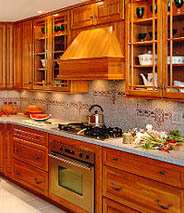 From 1989 to 2003, I was president and co-owner of Willow Glen Kitchen & Bath in San Jose, California, where I worked as a general contractor and one of the two principal kitchen and bath designers. I enjoyed this career while studying journalism at Santa Clara University.
Our enterprise was rather extensive. In addition to general contracting, we were cabinetmakers and Corian fabricators, with a large kitchen and bath showroom and a separate Arts & Crafts furniture and lighting showroom.
It was an extraordinarily creative period of my life, filled with beautiful cabinetry, lighting, furniture, pottery, unusual materials, elaborate designs, and the frequent urge to turn an otherwise respectable bathroom into a work of art.
The entire enterprise was an absolute blast, in more ways than one.
I’ve been an artist since I was knee-high to a grasshopper, so naturally, I decided it would be a great idea to start sandblasting designs onto Corian and hand-painting them with acrylics.
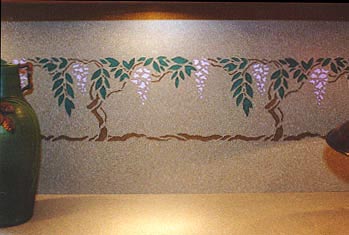 For those not in the know, Corian is a solid-surface material commonly used for countertops, backsplashes, and bathrooms. Because it’s made primarily of acrylic resin and minerals, acrylic paint bonds to the areas that are abraded with techniques such as sandblasting. When I began doing sandblasting Corian in 1991, no one else was doing it. Sandblasting was strictly limited to commercial applications, usually signage, and always with materials such as wood. But I asked myself, “Why wouldn’t this work with Corian? And wouldn’t it be cool if it did?” And off I went.
By the time our showroom opened in 1991, my work had already attracted attention in national design publications, and the awards would soon follow.
More About Sandblasting: It’s Messy
Sandblasting involves directing an abrasive stream of sand at a surface to remove material and create a design. With the right techniques, it’s possible to produce intricate patterns that resemble carved stone, sculptured tile, or decorative architectural ornamentation.
It’s also painstaking work. Every design had to be carefully planned, positioned, and executed by hand. For the artwork I did, the process involved cutting away a thick rubber adhesive from the areas to be sandblasted with an X-Acto knife, which required a steady hand and considerable patience. Some pieces were left with their natural sandblasted finish, while others were painted with metallic pigments, acrylics, or gold leaf.
I particularly loved the Arts & Crafts and Art Nouveau movements, with their beautiful botanical patterns, flowing lines, and attention to craftsmanship. Flowers, trees, vines, geometric borders, woodland scenes — almost anything could become a decorative feature. And almost anything did.
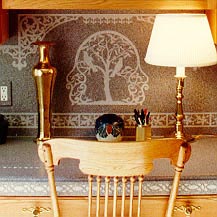 I sandblasted backsplashes, fireplace surrounds, decorative tiles, vanity tops, and even the front edges of countertops. Yes, the countertop edges. Ordinarily, the edge of a countertop is not something people spend much time admiring. It’s just there, doing its job. But I discovered that a carefully sandblasted border could make an ordinary countertop look like a piece of carved architectural ornamentation. Apparently, leaving the front edge of a perfectly good countertop undecorated was simply more restraint than I could muster.
Then Things Got a Little Out of Hand
When we opened our showroom, I had an opportunity to experiment with larger and more elaborate designs. Our showroom became something of a playground for my artistic imagination. The building was a 150-year-old general store with multiple rooms, so we had plenty of space to work with.
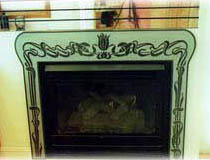
There were two working fireplaces, one decorated with an Art Nouveau motif and the other with an Arts & Crafts design. In the front showroom, we installed a working two-person whirlpool surrounded by original sandblasted artwork. Numerous other displays featured ornate, hand-painted, sandblasted backsplashes.
The design area where we worked with homeowners had a twelve-foot Corian desk with a full-height sandblasted backsplash. We even created a showroom sign from Corian that looked like carved stone.
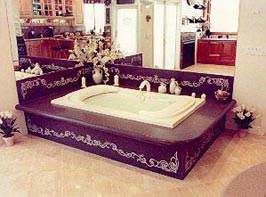 My partner, Paul Cullen, would first fabricate the Corian — be it a countertop, backsplash, or whatever. Then I would go at it with rubber, X-Acto knife, sand, and then paint. That collaboration allowed us to explore some rather unusual possibilities, both personally and professionally.
1994 was a strange year. We had a 100-pound Rottweiler named Gator who spent his days in our showroom, greeting customers as they came through the door. That fall, Kitchen & Bath Business magazine got wind of Gator and decided to do a full spread on him titled “PR That Drinks From a Bowl.”
Gator was deeply honored by the attention and graciously accepted a cookie.
When it came to my artwork, I also enjoyed working with designs by other artists, including Helen Foster, Trimbelle River, and Bradbury & Bradbury Art Wallpapers, adapting their beautiful patterns to sandblasted surfaces.
The results could be wonderfully dramatic. Some pieces were subtle enough that you had to look closely to appreciate them. Others made absolutely no attempt at subtlety. I enjoyed both.
The Awards That Found Their Way Into the Picture
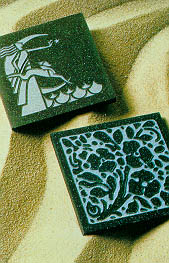 As the years went by, my unusual experiments with Corian attracted more attention than I ever expected. The work was featured in kitchen and bath industry publications, and over the years my designs received thirteen national design awards.
One of the fireplace surrounds won first place in a 1996 national design competition. And our showroom received multiple awards for its innovative use of materials and commercial interior design.
Some of my sandblasted tiles were exhibited in the DuPont Corian booth at the 1994 National Kitchen and Bath Show in Chicago. Later that year, Sunset magazine featured a number of my sandblasted tiles.
I was delighted, of course. But what I remember most fondly is the creative process itself: figuring out how to make an unusual idea work, experimenting with materials, and finally seeing a design come together.
There’s something deeply satisfying about imagining something that doesn’t yet exist and then making it real. Even when the thing you’ve imagined requires spending an unreasonable amount of time decorating the edge of a sink.
Bringing Nature Indoors
 Some of my favorite projects were inspired by nature. For one kitchen, I created a series of hand-painted irises sandblasted into a Corian backsplash. The homeowners loved irises and wanted something personal rather than a conventional decorative treatment. For another project, I created a twelve-foot-long mural depicting the rolling hills of Sonoma County.
Other designs featured dragonflies, wisteria, woodland scenes, flowers, and stylized trees.
I also worked with ceramic tile, including a fireplace design inspired by the Arts & Crafts ceramic tradition. The tiles were sandblasted, reglazed, and fired to create a landscape scene.
What appealed to me about these projects was their individuality. A kitchen didn’t have to look like every other kitchen. A bathroom could have personality. A fireplace could become a piece of artwork. And sometimes a single small decorative tile could completely change the character of a room.
Of Course, I Couldn’t Leave My Own House Alone
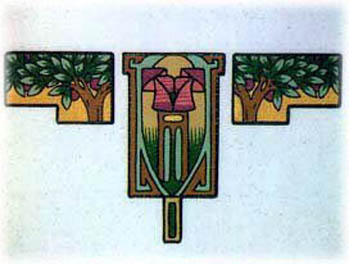
Naturally, my enthusiasm for decorative design followed me home. My own kitchen became one of my projects, with intricate Arts & Crafts patterns incorporated into the backsplash. My home office has an ornate sandblasted backsplash, and I have several bed headboards featuring sandblasted designs.
I also created several decorative wall pieces that remain in my home today, including two intricate sandblasted designs hanging in my hall bathroom. My fireplace features a ceramic-tile landscape inspired by the Arts & Crafts tradition.
Apparently, once I discovered that walls, countertops, and fireplaces could be decorated, there was no turning back. Fortunately, I eventually found other outlets for my creativity. Otherwise, I might have started sandblasting the furniture.
From Sandblasting to Psychology
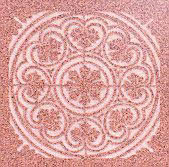
People sometimes wonder how someone moves from kitchen and bath design into psychology. To me, the two worlds aren’t quite as unrelated as they might seem.
Kitchen and bath design involves paying attention to what people need, often couples. You notice their particular habits, proclivities, and the details of their everyday lives. You try to understand what someone wants, sometimes before they can fully articulate it, and you work toward creating something meaningful that will enrich their lives.
Psychology requires a different kind of attention, but the desire to understand what makes something — or someone — unique has always interested me. Of course, there are important differences. People are considerably more complicated than kitchens and baths. And sandblasting is generally frowned upon in psychotherapy.
Looking back, I’m grateful for those years of artistic exploration. They gave me the opportunity to work with my hands, experiment with unusual materials, collaborate with talented people, and create things that still bring me pleasure decades later. I still draw and paint today but I’ll tell you a secret: I miss sandblasting.
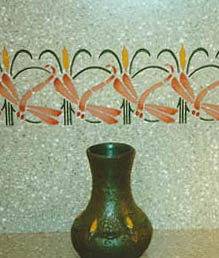 The photographs accompanying this article are from that chapter of my life, mostly from the 1990s. They’re not the crisp digital photographs we’re accustomed to today, but they preserve something precious to me: the pleasure of making things.
I still love the intricate patterns, the warm wood cabinetry, the botanical designs, and those wonderfully decorative countertop edges. And I still think some of them are pretty darn cool. Even if I do say so myself.
Randi Fredricks, Ph.D.
Companion Song:
— She’s a Rainbow, Rolling Stones, 1967
Author Bio
Randi Fredricks, Ph.D. is a best-selling author and provocateur whose work explores love, relationships, sexuality, spirituality, and the magnificent complexity of being human. For more than three decades, she has explored what helps people connect more deeply, love more courageously, and create extraordinary relationships. Her writing blends psychology, spirituality, humor, and eroticism, with a particular passion for restoring the dignity and value of men and exploring the possibilities of Hot and Holy Love. At the heart of her work is a simple conviction: all human beings deserve and are capable of extraordinary love — and a beautiful life.