Pleats, pipes, and the holy gust of wind.
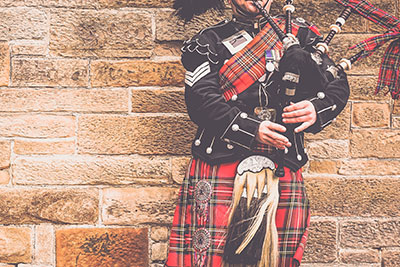 It’s a bright Saturday morning on a Highland Games field. The grass is still damp. Somewhere behind the beer tent, a set of bagpipes is warming up with a sound like a goose being gently reasoned with. The smell of meat pies is drifting across the field, and a little girl in a tartan sash is chasing a border collie who clearly thinks he’s in charge.
And in the middle of the field stands a man in a kilt.
He is built like a refrigerator that took up yoga. His socks are pulled up to his knees. His shirt sleeves are rolled to the elbow. He wipes his hands on a towel, bends down, and wraps his arms around the bottom of what can only be described as a telephone pole. He lifts it. He balances it straight up against the sky. He starts to run.
And right at that moment, as the whole crowd holds its breath, a breeze comes rolling across the field.
Ladies, I have seen the face of God. And it was wearing tartan.
The Eternal Question
Let’s get this out of the way, because I know exactly what you’re thinking.
What’s under there?
Tradition holds that a true Scotsman wears nothing at all beneath his kilt. Some men honor that tradition devoutly. Some wear compression shorts and a sly smile. Some will tell you it’s none of your business, which is exactly the right answer and somehow makes it worse.
Here is my position on the matter: I don’t need to know. In fact, I’d prefer not to.
Because the not-knowing is the entire point. A kilt is the only garment in Western civilization that turns a man into a walking mystery. Every staircase becomes suspense. Every gust of wind becomes an event. Every time he sits down on a hay bale, an entire grandstand of women quietly lowers their sunglasses.
The kilt doesn’t reveal. It suggests. And suggestion, as any woman can tell you, is a hundred times sexier than a billboard. And let’s not overlook the accessories, because the kilt comes with a whole liturgy. There’s the sporran, a little leather pouch worn front and center, which is either a very practical wallet or the most strategically placed decoration in the history of fashion. There’s the kilt pin, the knee socks, the flash of colored garter peeking out at the calf. And on the formal ones, a small knife tucked into the top of the sock, which I find both alarming and deeply reassuring.
A man in full kit has clearly put some thought into getting dressed. That alone is worth a standing ovation.
So let the mystery stand. Some questions are holier unanswered.
The Confidence of a Man in a Skirt
Now I’m going to say something a lot of people won’t. A kilt is a skirt.
Yes, I know. I can already hear the bagpipes of outrage tuning up. It’s not a skirt, it’s a kilt. Fine. It’s eight yards of pleated wool worn below the waist and above the knee. You can call it whatever you like, sweetheart. I’m not here to argue. I’m here to admire. Because that’s exactly what makes it so magnificent.
Think about what it takes for a man to stride across a crowded field in pleats. He has to be utterly unbothered. He cannot be worried about whether anyone thinks he looks silly, because the moment he worries, he does. A kilt worn sheepishly is a costume. A kilt worn with total, swaggering conviction is a declaration. And the declaration is this: I know exactly who I am. That is the sexiest thing a man can wear, and the wool is just the delivery system.
There’s a lesson in it for all of us. We spend so much energy trying to prove our masculinity or our femininity, our seriousness, our cool. Then a six-foot-four plumber from Fresno walks by in a kilt and knee socks, carrying a funnel cake, and makes all that effort look ridiculous. Confidence isn’t about what you wear. It’s about wearing it like you meant to.
Gloriously Pointless Heroics
Let’s talk about the athletics, because the heavy events at a Highland Games are the most beautiful nonsense ever invented by mankind.
The caber toss. A man picks up a tree trunk taller than his house and tries to flip it end over end so it lands pointing straight away from him, like the hand of a clock at twelve. Nobody needs this skill. No one has ever been rescued from a burning building by a well-tossed caber. It is purely, gloriously, magnificently unnecessary.
The stone put. A man throws a rock. As far as he can. That’s it. That’s the event. The hammer throw. A man plants his boots, sometimes with blades on the toes dug right into the turf, whirls a heavy ball on a long handle around his head like he’s trying to start a helicopter, and lets it fly. The crowd ducks instinctively, even when they’re standing well behind the fence.
The weight over the bar. A man swings a heavy iron weight between his legs and hurls it straight up over a bar higher than a basketball hoop, then gets out of the way before it comes back down to visit him.
I watch these events and something in my heart swells. Because these are men doing something hard, for no reason at all, just to see if they can. Not for a paycheck. Not for a promotion. Not to provide or protect or fix anything. Just for the sheer joy of strength, and the roar of the crowd, and the big sweaty hugs from the other competitors afterward.
Men spend so much of their lives being useful. Here is one Saturday a year where they get to be magnificent instead.
And watch how they treat each other. A competitor misses his throw, and the man who just beat him walks over and slaps him on the back. They share chalk. They share advice. They cheer for each other’s personal bests. It is the opposite of everything the world tells us about male competition. It’s brotherhood, in plaid.
I once watched a giant of a man come up short on his final throw and stand there, hands on his knees, catching his breath. Before he could even straighten up, three of his competitors were around him, one with a water bottle, one with a towel, one telling him a terrible joke. He laughed so hard he had to sit down on the grass. Nobody shamed him. Nobody pretended not to see. They just carried him for a minute, the way good men do for each other when nobody’s looking.
Except somebody was looking. Me. And I want every woman who reads this to know what I saw: that’s what male strength looks like when it’s allowed to be generous.
The Pipe Band
And then the pipe band marches onto the field, and every woman in the grandstand has to take a moment.
Rows of men in full regalia. Kilts swinging in perfect time. Feather bonnets, sporrans, polished shoes, crisp white spats. The drummers at the back, sticks flashing, faces dead serious. The pipers in front, cheeks full, eyes straight ahead.
The first note hits you somewhere behind the ribs. By the second, the hair on your arms is standing up. By the time they turn the corner in formation, you realize you’ve stopped breathing entirely and are holding your lemonade like it’s a religious relic.
What is it about a pipe band? I think it’s the discipline wrapped around the passion. Those men have rehearsed for hundreds of hours in cold church basements and VFW halls so that, for ten minutes on a summer field, they can move as one body and make one sound. That kind of devotion is attractive in itself. It says: I know how to commit to something. I know how to show up, over and over, for something bigger than me.
And then they march off, and you’re left standing in the grass, slightly dizzy, wondering whether it’s too late to take up the bagpipes yourself just to get closer to the action.
It is never too late, ladies. I’m just saying.
Clan and Belonging
Here is where I stop laughing for a moment, because the kilt is more than a costume or a show.
Every tartan means something. That pattern of crossing lines belongs to a family, a clan, a place. When a man wraps himself in his tartan, he is wearing his grandfather. He is wearing the grandfather before that, and the one before that, all the way back to some windswept glen where men he never met lived and loved and fought and buried each other.
I have watched an old man at the Games, bent with age, in a kilt faded nearly to gray, stand a little straighter when the pipes played his clan’s tune. I have watched a teenage boy in his first kilt, borrowed from his uncle and two sizes too big, walk across that field like a prince.
In a world that so often tells men they come from nowhere and belong to no one, the kilt says something tender and fierce: You come from somewhere. You belong to people. You are part of a story that started long before you, and it will go on long after you.
That’s what a man is carrying on his hips when he wears his tartan. Not just wool. Belonging. Lineage. Pride. A reminder that the men who came before him were magnificent too.
And it isn’t only for the bloodline Scots. At any Games you’ll meet men who discovered their great-great-grandmother was a MacLeod and have embraced it with the zeal of a religious convert. You’ll meet men with no Scottish blood at all, who simply fell in love with the music and the people and were welcomed in anyway. The clans have big tents. That’s another thing to love about them.
Is it any wonder women find that irresistible? A man who knows where he comes from is a man who knows how to build something that lasts.
Back on the Field
So there he is again. The refrigerator who took up yoga. The caber balanced straight up against the sky. The crowd silent. The wind picking up.
He runs three steps. He plants his feet. He heaves. The caber rises, hangs in the air for one long, impossible second, and turns over clean. It lands at twelve o’clock. The crowd erupts. His friends come running. He throws his arms in the air and lets out a roar that probably scares sheep in Inverness.
And just at that moment, the breeze catches his kilt.
I will not tell you what I saw. A lady never tells. Some questions really are holier unanswered.
But I will tell you this. As I stood there in the grass, with the pipes starting up again and that magnificent man laughing in the sunshine, one thought filled my heart with perfect certainty.
God loves women.
And He has a wonderful sense of humor.
Randi Fredricks, Ph.D.
Companion Song:
—“Prickly Thorn, But Sweetly Worn,” The White Stripes, 2007
This article is based on concepts from Randi Fredricks, Ph.D.’s book Magnificent Men: How Men Are Undervalued and How Worshipping and Being Worshipped Can Bring You The Hot and Holy Love You Desire, exploring the restoration of men’s dignity and worth, the sacred and sensual dimensions of intimacy, and hot and holy love.
Author Bio
Randi Fredricks, Ph.D. is a best-selling author and provocateur whose work explores love, relationships, sexuality, spirituality, and the magnificent complexity of being human. For more than three decades, she has explored what helps people connect more deeply, love more courageously, and create extraordinary relationships. Her writing blends psychology, spirituality, humor, and eroticism, with a particular passion for restoring the dignity and value of men and exploring the possibilities of Hot and Holy Love. At the heart of her work is a simple conviction: all human beings deserve and are capable of extraordinary love — and a beautiful life.