It’s a Thing.
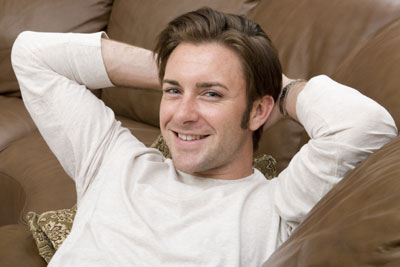 The Day You Realize You’re Doomed
Every woman has a day. She may not mark it on a calendar. She may not even recognize it while it’s happening. But somewhere in the timeline of her relationship, there is a specific, identifiable moment when she understands, with the sudden clarity of a smoke alarm going off in a quiet house, that she has lost. Not lost an argument. Not lost her keys. Lost something much bigger and much more permanent: her ability to say no to this particular man about this particular thing, possibly ever again.
It wasn’t the muscles.
She’d braced for the muscles. She’d seen him carry in the groceries, six bags per arm, wordlessly, like it was nothing, like he was auditioning for a personality he didn’t actually need to audition for because she’d already fallen for him three dates earlier over cheap wine and a shared appetizer. The muscles were nice. The muscles were, frankly, a known quantity. She’d built up a tolerance.
It wasn’t the confidence, either. The way he walked into a room like he already knew where the exits were and didn’t care, like the room was lucky to have him in it. Confidence is attractive, sure, but confidence is also loud. Confidence announces itself. You can see it coming from across a parking lot, and by the time it arrives, you’ve already decided how you feel about it.
It wasn’t the car. Everyone thinks it’s going to be the car — some low-slung, throaty-engined thing that he treats with more tenderness than he treats his own knees — but no. Cars are for strangers. Cars are for the version of him that exists in photographs. Cars do not survive first contact with real domestic life, which mostly involves parallel parking and complaining about premium gas prices.
It wasn’t even the paycheck. Financial stability is lovely, genuinely, deeply lovely, the kind of lovely you don’t fully appreciate until you’ve dated someone who considers a payment plan a personality trait. But money is abstract. Money is a number on a screen. Money has never once made a woman set down her fork, sigh from somewhere near her sternum, and say, “Fine. FINE. We’ll get the dog.”
No. It was none of those things.
It was the look.
You know the one. If you are reading this and you are currently, or have ever been, in a long-term relationship with a man, you already know exactly the look I mean, and you are probably smiling right now in a way that is seventy percent affection and thirty percent low-grade betrayal. This is the look that arrives quietly, almost shyly, and dismantles every ounce of resolve you thought you had. This is the look that has convinced grown women — competent, accomplished, occasionally terrifying women who negotiate salaries and raise children and once talked a mechanic down four hundred dollars on principle alone — to say yes to things they had, five minutes prior, sworn on their own mother’s grave they would never, ever allow.
We are talking, of course, about puppy dog eyes.
Here is the joke, the central, load-bearing joke of this entire article, the one you should keep tucked in your back pocket for the next seven sections: men absolutely, one hundred percent, without a shred of ambiguity, know what they’re doing.
They will deny this. They will look you dead in the face — sometimes even using a lesser, off-brand version of the very expression under discussion — and insist that they have no idea what you’re talking about, that their face simply does this sometimes, that it’s just how their eyebrows are shaped, genetics, really, nothing more. This is a lie. It is a beautiful, charming, well-rehearsed lie, delivered by a man who has clocked, with the precision of a Swiss watchmaker, the exact millisecond your resistance began to soften.
Because somewhere — maybe in childhood, maybe in adolescence, maybe in some primordial cave where a smaller, hungrier version of him once widened his eyes at a woman holding the last piece of roasted mammoth — a man discovers that his face is capable of something extraordinary. He discovers that if he tilts his head just so, raises his eyebrows just enough, and lets his mouth do that small, hopeful, almost apologetic thing, an entire category of “absolutely not” quietly rearranges itself into “well, maybe.”
And once he discovers this, he never, ever forgets it.
This is not a con. Let’s be extremely clear about that up front, because we are going to spend the next several thousand words laughing at men, lovingly, and I don’t want anyone walking away thinking this is secretly an indictment. Puppy dog eyes are not a manipulation tactic on par with, say, gaslighting someone about whether they left the stove on. This is not a man weaponizing his face to extract cash or compliance from an unwilling participant. It is something much sillier and much sweeter than that. It is a grown man, fully capable of speaking in complete sentences, choosing instead to communicate a desire through an expression so nakedly hopeful that it should, by all rights, be illegal in at least four states.
And the truly delicious irony — the thing that makes this whole phenomenon worth 5,000 words instead of a shrug and a raised eyebrow — is that the very thing making him irresistible in that moment is not his strength. It’s his surrender. It’s the fact that for two or three seconds, the confident, capable, grocery-carrying, room-owning man decides to set all of that down and simply ask, plainly, with his whole hopeful face, for something he wants. He makes himself, on purpose, a little bit powerless. And it works better than anything else in his entire arsenal.
So this is a love letter, in essence. A long, funny, deeply affectionate love letter to every man who has ever looked at his partner across a kitchen island with wide eyes and a hopeful smile and gotten exactly what he wanted. It is also, quietly, an exploration of something a little more tender underneath all the jokes: that vulnerability — real, unguarded, slightly ridiculous vulnerability — might be the single most attractive thing a man can offer. Not the car. Not the paycheck. Not even the muscles.
The look.
It’s a thing. And once you see it, you cannot unsee it — and, more importantly, once you fall for it, you never really stop.
Every Woman Knows Exactly The Look
Describing “the look” to someone who hasn’t experienced it firsthand is a bit like describing a specific shade of sunset to someone who’s never seen one. You can list the technical components. You can point at the individual pieces. But something essential is lost in translation, because the real power of the thing isn’t in its parts — it’s in the way those parts assemble themselves, instantly and without conscious effort, into an expression that bypasses your rational brain entirely and goes straight for something older and softer underneath.
But let’s try anyway, because it’s worth cataloguing.
It begins, almost always, with the head tilt. Not a dramatic tilt — nobody is doing an interpretive dance here — but a small, almost imperceptible lean, maybe fifteen degrees, the kind of angle a golden retriever adopts when it hears the word “walk” from two rooms away and needs to confirm it wasn’t a trick of the wind. The head tilt does an enormous amount of quiet work. It signals uncertainty, a little bit of vulnerability, a willingness to be told no — even though both of you know, on some level, that “no” is currently on very thin ice.
Then come the eyebrows. Raised, but not alarmed — this is a crucial distinction. Alarmed eyebrows say, “Is the house on fire?” Hopeful eyebrows say, “Could we maybe, possibly, if it’s not too much trouble…” The eyebrows are doing the emotional heavy lifting of an entire paragraph of pleading, without a single word being spoken.
Below the eyebrows, the eyes themselves widen, just slightly, just enough to let in a little more light, a little more longing. This is not a wide-eyed stare — nobody wants to date a man who looks like he’s been personally startled by a home appliance. It’s softer than that. It’s an opening. An invitation. The eyes seem to say, quietly, “I know I shouldn’t ask…”
And then there’s the mouth — the final, devastating detail. Not a full grin. A full grin would ruin the whole effect; a full grin says “I’m already confident I’ve won,” and confidence, as we’ve established, is the wrong tool for this particular job. Instead, there’s a small, closed-lip smile, maybe with the faintest hint of teeth trying not to show themselves, the kind of smile that seems to be biting back its own optimism. It’s a smile that says, “…but maybe…”
Put it all together—the tilt, the brows, the eyes, the almost-smile—and the whole expression resolves into a single, unmistakable sentence that requires no translation whatsoever:
“Please?”
That’s it. That’s the whole vocabulary. One word, delivered entirely through facial architecture, and somehow it lands with more persuasive force than an hour-long PowerPoint presentation complete
with pie charts and a strongly worded appendix.
But every now and then, a man discovers there’s an even more powerful version.
It’s almost unfair.
He keeps the puppy dog eyes exactly where they are…
…leans in just a little…
…and quietly says:
“Pretty please?”
At that point, many women don’t even bother pretending to resist. They know exactly what’s happening. He knows exactly what’s happening. Somewhere, deep inside, she knows she’s already lost.
She may still sigh.
She may still roll her eyes.
She may even mutter, “Don’t look at me that way…”
But internally she’s already thinking,
“Well…I suppose one more motorcycle can’t hurt…”
Here is the remarkable part: no woman needs this explained to her. You could show this look to a woman who has never met the man deploying it, a total stranger standing next to her in a grocery store checkout line, and she would immediately, instinctively, recognize exactly what’s happening. She’d probably even glance over sympathetically at whoever’s on the receiving end, because she’s been there. We’ve all been there. There is no cultural translation required, no manual, no footnote. The look transcends language, geography, and generation. Somewhere right now, in a hundred different countries, in a hundred different languages, a woman is watching a man do this exact expression and thinking the exact same thought in whatever language she dreams in: Oh, here we go.
Part of what makes the look so universally recognizable is that it isn’t really invented by the men who use it — not consciously, anyway. It’s borrowed, whether they realize it or not, from something ancient and adorable and four-legged. Puppies discovered this expression roughly forty thousand years before men did, and evolutionary biologists will actually tell you, with entirely straight faces, that dogs developed extra eyebrow muscles specifically because it helped them communicate with humans — because humans, it turns out, are suckers for a hopeful face. It is, quite literally, evolutionarily advantageous to look like you’re asking permission. Dogs figured this out first. Men figured it out shortly after, probably around age six, probably in a toy aisle, and never looked back.
Which is why the name fits so perfectly. It isn’t called “the ask” or “the ploy” or “the ambush.” It’s called puppy dog eyes, because the resemblance is uncanny, and because the emotional effect is identical: an overwhelming, slightly irrational urge to give the creature in front of you whatever it wants, immediately, no questions asked, followed swiftly by another treat, just in case.
And here’s the thing that makes the whole phenomenon so charming rather than annoying: the look only works because it’s honest, in its own weird way. He’s not hiding what he wants behind some clever argument. He’s not building a case. He is standing there with his entire face saying, plainly, I want this, and I’m a little nervous you’ll say no, and I’m asking anyway. There’s something disarming about a grown man choosing to be that transparent, even over something as small as a second slice of pie. It’s oddly brave, in the smallest possible way. And women, it turns out, are suckers for small bravery dressed up as big hope.
So no, nobody needs the look explained to them. Every woman alive has a mental file, somewhere, cross-referenced under “things that have gotten me to say yes against my better judgment,” and this look sits comfortably at the top, right above “the way he says my name when he wants something” and several notches above “his mother’s cooking.”
The Moment He Discovers It Works
Every man remembers, on some level, the first time it worked. It might not be a conscious memory — he’s not likely to sit you down over dinner and reminisce, “Ah yes, I recall the exact evening I discovered my facial expressions had monetary value” — but somewhere in his personal history, there was a moment. A specific ask. A specific look. A specific, stunning victory.
Maybe it was dessert. This is the classic entry point, the gateway drug of the puppy dog eyes economy. Dinner’s over, plates are cleared, and he’s eyeing the last slice of cake that was, by every previous agreement, supposed to be split evenly or saved for tomorrow. He doesn’t say anything at first. He just looks at the cake. Then he looks at her. Then the eyebrows go up, the head tilts, and suddenly an entire slice of cake — the whole thing, not even split — finds its way onto his plate while she watches, laughing, wondering how exactly this happened when she’d walked into the kitchen fully intending to enforce the fifty-fifty rule.
Maybe it was bigger. Maybe it was the motorcycle — the one he swore he was “just looking at,” the one he’d pulled up on his phone eleven times over the course of a single dinner, angling the screen just slightly so she’d catch a glimpse without him technically asking. He didn’t launch into a sales pitch about horsepower or resale value. He just looked at her, eyes wide, hopeful, faintly apologetic, like he already knew it was a big ask and was bracing for the no. And that bracing — that visible, endearing nervousness — turned out to be the most persuasive thing he could have done. Three weeks later there’s a motorcycle in the garage and a helmet with her name on it, because apparently if you’re going to enable this behavior, you might as well ride along.
Maybe it was the guitar — the fourth one, mind you, joining three others that already lived in various states of “I’m definitely going to learn to play this” around the house. Maybe it was the wagon-wheel coffee table, a piece of furniture so aggressively, unnecessarily rustic that it defied every design principle in the house, and yet there it now sits in the living room, because he looked at her in the furniture store with those eyes and she thought, quietly, well, it is kind of charming, in a deeply stupid way. Maybe it was the jacket — leather, absurd, entirely impractical for the climate they live in — that he wears now with the smug satisfaction of a man who knows he got away with something.
Maybe it was the giant television, the one that required its own delivery crew and a minor renovation of the entertainment console, purchased under the argument that it was “on sale” and would “really improve the movie nights,” an argument that had nothing to do with the actual purchase decision, because the actual purchase decision was made the second he turned to her with that look and she felt something in her chest go soft and traitorous.
Or — and this one deserves its own paragraph, because it’s the classic, the platinum standard, the Everest of puppy dog eyes achievements — maybe it was another dog. The great irony of it all, really: a man using an expression borrowed from dogs in order to acquire an actual dog. There is something almost poetic about a grown man standing in front of a shelter kennel, or crouched next to a box of puppies a coworker is trying to rehome, turning to his partner with those exact eyes, essentially performing the emotional equivalent of what the puppy itself is doing three feet away. Double puppy dog eyes. An unstoppable force. She never had a chance.
Whatever the specific object of desire, the mechanics of the moment are always roughly the same. He asks — not forcefully, not with an agenda, but almost shyly, like he’s testing the water with one toe. She hesitates. She starts to say something reasonable, something budget-conscious, something involving the phrase “we already have three of those.” And then the look arrives. Not calculated, not really — or at least, not consciously calculated, not in the moment. But somewhere behind his eyes, some ancient, animal part of his brain recognizes an opportunity and deploys the exact expression built for it.
And she caves.
She may put up token resistance on the way down — a sigh, an eye roll, a “you’re impossible,” a “we are absolutely not doing this again” — but the outcome was decided the second the eyebrows went up. And here is what makes this moment so important, so foundational to everything that follows: he notices. He notices immediately. Somewhere behind that hopeful, slightly bashful expression, there’s a full internal celebration happening — quiet fireworks, a small victory lap, the mental equivalent of a fist pump — and he files this information away with the seriousness of a man discovering a cheat code in a video game he’s been playing his whole life.
From this moment forward, nothing is the same. He now knows something about himself, about her, and about the two of them together that cannot be unknown. He has found the key. And like any reasonable person who has just discovered a key that opens a very specific, very useful door, he is absolutely going to use it again.
Men Keep Using It Because It Actually Works
Here’s where it would be easy to make this whole thing sound a little sinister — a man, armed with a facial expression, systematically working his way through a partner’s defenses like some kind of eyebrow-based con artist. But that’s not actually what’s happening, and it’s worth slowing down to understand why, because the distinction matters.
He’s not manipulating. Manipulation implies deception — hiding your real motive, disguising what you want as something else, working an angle the other person can’t see. Puppy dog eyes are the opposite of that. They are, if anything, embarrassingly transparent. There is no hidden agenda tucked inside a hopeful eyebrow raise. The agenda is the eyebrow raise. He wants the thing, and his face is telling you exactly that, with all the subtlety of a neon sign. If this is manipulation, it’s the most honest manipulation in the history of relationships, conducted entirely out in the open, with both parties fully aware of what’s happening.
What he’s actually doing is inviting. There’s a real difference. An invitation can be declined. An invitation doesn’t come with pressure or guilt or consequences if the answer is no — and this is important, because the entire look falls apart, becomes something else entirely, something less charming, the moment it’s paired with sulking or resentment when the answer doesn’t go his way. The good version of puppy dog eyes, the version we’re actually talking about here, always comes with an escape hatch built in. If she says no, he shrugs, maybe laughs at himself for trying, and moves on with his day. The ask was genuine, but so was his acceptance of the possible no. That’s what keeps it playful instead of pressuring.
What he’s really doing, underneath all the theater, is exposing hope. That’s the actual mechanism, and it’s a lot more vulnerable than it looks. To ask for something you want — plainly, without pretense, without pre-armoring yourself against disappointment — is to admit that you want it. Wanting things is risky. Wanting things and having someone say no to them stings a little, even over something as small as cake. So most of the time, in most contexts, we protect ourselves from that sting by pretending we don’t care that much. “Eh, I don’t really need it.” “It’s fine either way.” “Whatever you think.”
That’s the armored version of asking.
Puppy dog eyes are the unarmored version. He’s not pretending indifference. He’s doing the opposite — leaning all the way into how much he wants the thing, letting his whole face show it, making himself just vulnerable enough that saying no to him would require actively overriding a visibly hopeful person. That takes a strange kind of nerve, even if he’d never describe it that way himself.
And because it works — because it keeps working, over and over, across years of shared groceries and shared bank accounts and shared furniture decisions — he starts to have fun with it. This is where the exaggeration comes in. He’ll lean harder into the expression than the situation strictly requires. He’ll deploy it over increasingly minor stakes, half as a real ask and half as a bit, because by this point in the relationship, both of you know exactly what’s happening, and that shared knowledge becomes its own kind of fun. He’ll widen his eyes over something as trivial as who gets the last piece of bacon, fully aware that the display is a little ridiculous, fully aware that she knows it’s a little ridiculous, and doing it anyway because the theater of it has become its own reward.
He knows exactly what’s coming, too. He can practically narrate the sequence in advance: she’ll laugh first — a short, surprised exhale, because even after years together, the sheer audacity of the attempt still catches her off guard. Then she’ll sigh, the universal sound of resistance beginning its slow collapse. And then, almost always, she’ll give in, sometimes with a token protest, sometimes with none at all, sometimes with a look of her own that says, quite clearly, you absolute menace, take the bacon.
The reason this cycle never gets old, at least not for a very long time, is that it isn’t actually about the bacon, or the cake, or the motorcycle, or any of the individual objects that trigger it. It’s about the tiny, low-stakes ritual of hope and response — of one person openly wanting something and another person deciding, again and again, to say yes to that wanting. Repeated enough times, that ritual stops being about acquisition entirely and starts being about connection. Which is, as it turns out, exactly where this whole story is headed.
Why Women Secretly Love It
Here’s the part where we stop laughing quite so hard and start being honest about why this actually works, because the psychology underneath the comedy is genuinely lovely, and it deserves its own spotlight.
Women often love seeing his playful side. Long-term relationships, for all their comfort and security, come with a real risk of flattening. Bills get paid. Errands get run. Schedules get coordinated with the grim efficiency of a small logistics company. Somewhere in the routine of adult life, it’s easy to lose sight of the fact that this is also a person you find delightful — someone with a sense of humor, someone capable of being a little silly, someone who doesn’t take everything, including himself, quite so seriously all the time. Puppy dog eyes are a small, reliable reminder of that playfulness. They’re proof that underneath the guy who handles the mortgage and takes out the trash and has opinions about tire rotation schedules, there’s still someone who thinks it’s funny — and worth doing — to beg with his eyebrows over the last piece of pizza.
There’s also his little-boy side, which is a different thing from playfulness, softer and a little more tender. Every adult carries some version of the child they used to be, and most of us keep that version pretty carefully hidden, especially men, who are often handed a cultural script about stoicism and self-sufficiency starting practically from birth. Puppy dog eyes let a little bit of that younger self peek out — the version of him who once looked at his own mother with the exact same expression, hoping for a second cookie or five more minutes before bedtime. Seeing that flicker of the boy inside the man isn’t infantilizing; it’s humanizing. It’s a glimpse of continuity, proof that the person standing in front of her carries his whole history inside him, including the parts that are still hopeful and small and easy to charm.
Then there’s his optimism, which might be the most underrated ingredient in the whole recipe. To ask for something with hopeful eyes rather than a defeated shrug is to assume, on some level, that the answer might be yes. That’s not nothing. Optimism is attractive precisely because it’s a little bit fragile — it requires believing in a good outcome despite the very real possibility of disappointment. A man who still approaches his partner with genuine hope, even over something as small as dessert, is a man who hasn’t grown cynical about being told no. That’s worth noticing, and worth rewarding.
His excitement plays a role too. There’s real pleasure in watching someone want something openly. Excitement is contagious in a way that indifference simply isn’t — it’s much more fun to be around someone lit up about a new guitar or a new gadget or a new adventure than someone who greets every possibility with a shrug. His enthusiasm, even over ridiculous things, even over the wagon-wheel coffee table that has absolutely no business existing in a modern living room, brings energy into the relationship that would otherwise be missing.
And then there’s the hopeful anticipation itself — the moment right before the answer, when he’s watching her face for a sign, when the whole outcome is still genuinely uncertain from his side of things. That moment of suspended hope is oddly intimate. He’s not performing confidence in that instant. He’s just waiting, openly, for her decision, trusting her with the power to say yes or no.
Which brings us to the real heart of it, the thing underneath all the smaller things: it reminds her that he trusts her enough to ask.
Think about what it actually takes to ask someone for something plainly, without hedging, without pre-loaded excuses, without protecting yourself in advance from a possible no. It takes trust. It takes believing that this particular person, out of everyone in the world, is safe to be vulnerable with — that she won’t mock the want, won’t hold it against him, won’t make him feel small for wanting something in the first place, even if the answer ends up being no. Every time he does the look, he is quietly re-confirming that trust. He’s saying, without saying it: I feel safe enough with you to want things out loud.
That’s the innocence that’s so incredibly attractive, and it’s worth being precise about what “innocence” means here, because it isn’t about naivety. It’s about the absence of self-protection. He’s not guarding himself against her reaction. He’s just standing there, hopeful, exposed, asking. And there is something deeply moving about a person choosing, again and again, over years, to remain that open with you — to keep showing up with hope instead of armor, even after all the times reality could have taught him to protect himself instead.
This is, in miniature, one of the most important truths about intimacy: it isn’t built primarily out of strength on display. It’s built out of the small, repeated moments where someone lets you see them wanting something, needing something, hoping for something — and trusts you not to make them regret it. Puppy dog eyes over a slice of cake are a low-stakes rehearsal for something much bigger: the willingness to be vulnerable at all, about anything, with another person. A man who can do it easily over dessert has usually built the muscle to do it, eventually, over things that matter enormously more.
The Running Joke Every Couple Develops
Give it enough time — a year, maybe two, certainly by year five — and puppy dog eyes stop being a spontaneous weapon and start becoming something closer to relationship folklore. Every long-term couple, if you talk to them honestly, has some version of this running joke, a shared script so well-worn that both people could recite either half of it from memory.
It usually starts the moment his face begins its telltale shift, and she catches it before he’s even fully committed to the expression. “I see those puppy dog eyes,” she’ll say, sometimes with real suspicion, sometimes already half-laughing, because she knows exactly what’s about to be requested and she’s already three moves ahead of him. “Don’t you dare,” she’ll add, which is, at this point in the relationship, more of a formality than an actual threat — the linguistic equivalent of a “no soliciting” sign that everyone involved knows gets ignored on a fairly regular basis.
“No,” she’ll say next, flatly, trying to close the door before it’s even fully open. But he’s already committed. The eyebrows are up. The head is tilted. There’s no retreat from this position, only advance. “Stop looking at me like that,” she’ll say, and there’s something wonderful about the fact that this instruction has never once, in the recorded history of any relationship, actually worked. Telling someone to stop looking at you with puppy dog eyes is a little like telling the tide to stop coming in — technically a sentence, not remotely a solution.
And then, eventually, inevitably: “Oh, fine.” Two words carrying the full weight of surrender, delivered with an eye roll that’s really more affection than exasperation, an eye roll that’s been doing this exact job for years and has gotten quite efficient at it.
This little script — I see it, don’t you dare, no, stop looking at me like that, oh fine — becomes a kind of relationship shorthand, a piece of private language that means far more to the two people using it than the words themselves would suggest to an outside observer. Every couple develops these. Some couples have a phrase for who’s driving, a phrase for when someone’s hangry, a phrase for that one restaurant they went to on a disastrous early date that’s now permanently funny instead of humiliating. The puppy dog eyes script is one of the most universal entries in this category, because the underlying dynamic — one person hopefully asking, one person theatrically resisting before caving — is close to a relationship constant.
What’s especially charming is watching the script evolve over time, the way any well-loved joke does. In year one, she might actually be surprised each time it happens, genuinely deliberating over whether to give in. By year five, she’s recognizing the wind-up before he’s even fully aware he’s doing it — she’ll catch the very first flicker of the head tilt and call it out preemptively, sometimes laughing before he’s said a single word, because the anticipation itself has become part of the fun. He’ll grin, not even offended at being caught so early, because getting caught was never really the point. The point was always the shared performance of it — the fact that they both know exactly what’s happening and are choosing, happily, to do the little dance anyway.
And when she starts laughing before he even asks, that’s mission accomplished, in a deeper sense than the original ask. He’s not just getting the cake or the extra ten minutes on the couch or whatever small thing prompted this particular round. He’s getting the laugh. He’s getting the specific, warm, this-is-us sound of her laughing at something only the two of them fully understand. That sound, repeated across years, becomes its own kind of currency — maybe the real thing he was after all along, disguised as a request for dessert.
This is, in essence, how relationships build their own private mythology. Not through grand gestures, most of the time, but through small, ridiculous, repeated rituals that accumulate meaning simply by being repeated. The puppy dog eyes bit isn’t funny because of any single instance of it. It’s funny — and sweet, and durable — because of the hundred instances before it, each one adding another layer to a joke that started small and somehow became load-bearing.
When Puppy Dog Eyes Become a Love Language
Here’s where the whole thing quietly deepens, and where a joke about dessert and motorcycles turns into something that looks a lot more like devotion.
Over years together, the eyes don’t stop working — but what they’re asking for starts to change. In the early days, the look is mostly transactional, mostly about objects: cake, guitars, a coffee table shaped like a wagon wheel for reasons no one can fully justify. But relationships mature, and so does the vocabulary of the look, until eventually it’s being used for things that have nothing to do with acquisition at all.
Sometimes now it’s asking for forgiveness. He said something thoughtless, forgot something important, let a bad day leak out onto her in a way he immediately regretted — and instead of, or alongside, an actual apology, there’s that same look, the same hopeful tilt, the same eyes that say I know I messed up, but can we be okay again? It’s a strange kind of magic that an expression built for negotiating dessert can also carry the weight of real remorse, but it can, and it does, and somehow it lands with just as much force, if not more.
Sometimes it’s asking for reassurance. A hard week at work, a moment of self-doubt he’d never fully put into words, and there’s that look again — quieter now, less playful, more searching — silently asking, are we good? Do you still choose me? It’s remarkable how much a face that started out negotiating for a second slice of pie eventually becomes fluent in negotiating for something so much more fundamental: the ongoing confirmation that he’s still loved, still wanted, still chosen.
Sometimes it’s simpler than that. Sometimes it’s just asking for affection — another hug, held a beat longer than strictly necessary. Another kiss, requested with the same shy hopefulness he once used to request a motorcycle, which is, honestly, a fairly wonderful thing to realize about a person: that he wants your kiss with the same open, unguarded enthusiasm he once wanted a large unnecessary television.
Sometimes it’s asking for five more minutes together — on the couch on a Sunday morning, neither of them needing to be anywhere, but the day pulling at them anyway with errands and obligations, and there’s the look, silently pleading for a little more time before the world reclaims them both. Sometimes it’s asking her to stay up with him a little longer, even though she’s tired, even though tomorrow’s early, because he wants just a bit more of tonight before it ends. Sometimes it’s as simple as asking her to hold his hand — not because he can’t reach for it himself, but because there’s something sweeter about being asked, about seeing that small hopeful flicker cross his face first.
By this point in the relationship, the look has stopped being funny, or rather, it’s stopped being only funny. It still carries a trace of its old comedy — some part of her will probably always smile at the theater of it, the familiar shape of an expression she’s watched evolve over years. But mostly, now, it’s beautiful. It’s a man who has spent years learning that he’s allowed to want things out loud, allowed to ask plainly, allowed to be a little vulnerable in front of the one person he trusts most — and instead of outgrowing that lesson, he’s simply widened its application. What started as a party trick for extracting dessert privileges has quietly become one of the primary ways he communicates his deepest, least defended feelings.
This is, in many ways, what a real love language looks like when it’s had time to mature. It’s not a formal declaration. It’s not a grand annual gesture. It’s a small, familiar, slightly ridiculous facial expression that has, through sheer repetition and shared history, become fluent in an enormous range of emotional vocabulary — hope, apology, reassurance, tenderness, longing — all delivered through the same basic architecture of a tilted head and hopeful eyes. She doesn’t need him to explain which meaning he intends this time. She just knows, the way you know your own name, the way you know the sound of a familiar car pulling into the driveway. Context tells her everything. The eyes just deliver it.
The Greatest Weakness You’ll Never Want to Lose
One day, maybe years into all of this, maybe on some ordinary evening involving nothing more dramatic than a kitchen and a conversation about dinner, she’ll catch him doing the look again — over something small, something silly, something that doesn’t even really matter — and she’ll realize, with a kind of amused, resigned affection, that she still melts. Every single time. After everything. After a hundred, maybe a thousand rounds of this exact bit, her defenses still don’t hold. The eyebrows go up, the head tilts, and something in her chest just quietly gives way, the same as it did the very first time, back before she even had a name for what was happening to her.
She’ll probably always melt. That’s the honest truth of it, the thing nobody warns you about when you first fall for someone with an expression like that: it doesn’t wear off. You don’t build immunity. There’s no point in the relationship where the look simply stops working, where you finally develop the resistance you always assumed, somewhere back in year one, that you’d eventually build. It just keeps working, gently, reliably, for as long as he keeps doing it and as long as she keeps loving him enough to let it.
And honestly, when she really sits with that fact, she finds she doesn’t want to become immune. There’s a strange comfort in remaining a little bit conquerable by this one particular person, in this one particular way. It would almost be sad if it stopped working — if one day the look landed on a face gone flat and unmoved, immune through sheer overexposure. That would mean something had dulled between them, some capacity for delight had worn thin. The fact that it still works, after all this time, is proof of something good: that she still sees him, still finds him charming, still enjoys being asked things by him even when she already knows the answer she’s about to give.
Because every relationship, if it’s lucky, deserves at least one completely unfair secret weapon — one small, ridiculous, entirely disproportionate advantage that one partner holds over the other, used not for real manipulation but for the simple ongoing pleasure of connection. Some couples have a particular voice one of them uses. Some have a specific dance in the kitchen. Some have an inside joke so old and so worn smooth by repetition that neither person could tell you anymore exactly how it started. And some, a great many, have this: a look, borrowed shamelessly from puppies, deployed shamelessly by grown men, that somehow still gets the job done after all these years.
And if his happens to be puppy dog eyes — if that’s the specific, unfair, wonderfully effective weapon he’s been given — then she’ll probably keep surrendering to it. Happily. Not because she has no choice, not really, but because some part of her has decided, quietly, a long time ago, that this is a fight worth losing, over and over, for as long as he keeps asking.
Because underneath the cake, and the motorcycle, and the wagon-wheel coffee table nobody needed, and the second dog they absolutely did not have room for, there was always something else being asked for, something much simpler than any of the objects themselves. He was asking to be seen wanting something. He was asking to be trusted with a no and given, instead, a yes. He was asking her to keep choosing him, in small moments, over and over, the same way he kept choosing to be that open with her.
And every time she says yes, she’s not just handing over the cake, or the guitar, or the last ten minutes on the couch. She’s saying: I still love watching you want things. I still love that you trust me enough to ask. I still love this hopeful, ridiculous, utterly transparent face of yours, and I hope you never, ever stop doing this to me.
It’s a thing.
And she wouldn’t have it any other way.
Randi Fredricks, Ph.D.
Chapter Companion Song Recommendation:
— Puppy Dog Eyes, Suki Waterhouse 2026
This article is an excerpt from Randi Fredricks, Ph.D.’s forthcoming book Magnificent Men: How Men Are Undervalued and How Worshipping and Being Worshipped Can Bring You The Hot and Holy Love You Desire, exploring the restoration of men’s dignity and worth, the sacred and sensual dimensions of intimacy, and hot and holy love.
Author Bio
Randi Fredricks, Ph.D. is a best-selling author, psychotherapist, and leading expert in counseling, communication, and human connection. Her first published study, released in 1993, explored the impact of family dysfunction on intimacy and communication in adult relationships. For more than three decades, she has developed innovative therapeutic models to help individuals and couples create deeper connection, emotional resilience, and extraordinary relationships. Her work explores the intersection of psychology, spirituality, humor, eroticism, and human magnificence, helping people live more fully, love more deeply, and embrace the extraordinary possibilities of a beautiful life.