The power of a woman’s hunger.
The Magnificent Protocol is a transformational exercise designed to help people recognize their own magnificence, reclaim their sense of worth, and become capable of receiving and giving extraordinary love.
The essential transformation is this: A person moves from recognizing magnificence in others to recognizing that same capacity for magnificence within themselves.
Its ultimate purpose is to strengthen someone’s ability to:
- Worship their partner wholeheartedly.
- Allow themselves to be fully worshipped.
- Abandon themselves to the ecstasy of deep love.
Let’s Begin
Most women who long to be loved and cherished already know that they long for it. What they have a harder time doing — what years of being told their needs are too much, their feelings too intense, their desires too demanding have made genuinely difficult — is believing, in the body, at the level where love and surrender and deep intimacy actually live, that they deserve to receive it without apology or negotiation.
Many women have spent years, sometimes decades, learning to call their own hunger excessive. To meet their longing with suspicion. To confuse their own disappearance with grace, and their own exhaustion with virtue. The concept of being truly worshipped — fully seen, deeply cherished, reverently desired — can feel almost dangerous to allow in, because wanting it openly has cost something before, and the nervous system remembers. This chapter is for those women. It is an invitation back to a self that has been waiting, quietly and patiently, beneath all the accommodating and the shrinking and the careful management of other people’s comfort, to finally be allowed to come home.
What I am about to show you is not fragility. It is not passivity, weakness, or submission. I am about to introduce you to three women whose courage became so undeniable that entire governments feared the moral force of their suffering. These were women whose convictions were so profound that their bodies themselves became instruments through which conscience could no longer be ignored. Their grace did not make them softer than steel. Somehow, it made their strength even more terrifying to those who sought to control them.
And then I am going to ask you to consider something extraordinary: that somewhere within you, that same sacred force still lives.
That consideration may not come easily. Most women have been taught, in ways so ordinary they barely registered as teaching at all, that their longings are liabilities. That wanting to be fully seen is neediness. That expecting reverence is arrogance. That the fire inside them — the particular ferocity that rises when something they love is threatened, the tenderness that runs so deep it sometimes frightens even them — is something to be managed and moderated rather than honored and trusted. Many women have become so skilled at making themselves small and safe and undemanding that they have nearly forgotten what it felt like before the training took hold. Nearly forgotten. But not entirely. Something in you recognized something when you read those words — that same sacred force still lives — and that recognition is not imagination. It is memory. And this chapter is going to help you find your way back to it.
The women in this chapter did not become magnificent because they were untouched by fear, loneliness, exhaustion, or pain. They became magnificent because there came a moment when preserving the integrity of their souls mattered more than comfort, obedience, approval, or survival itself. The ache of their hunger became a language. A declaration. A refusal. A prayer spoken through the body when ordinary words no longer carried enough truth.
As you move through these stories, some part of you will recognize them long before your mind fully understands why. You will recognize the exhaustion of carrying dignity through a world that often asks women to betray themselves in exchange for acceptance. You will recognize the tension between tenderness and ferocity. You will recognize the longing to remain soft without becoming weak, loving without disappearing, powerful without abandoning grace.
By the time you reach the exercise later in this chapter, something inside you will already have begun to shift. The noise will have quieted. The performance will have softened. And we will be able to speak directly to the part of you that still remembers what it feels like to be worthy of reverence, devotion, protection, ecstasy, and profound love.
This chapter is not about punishment, nor is it about suffering for its own sake. It is about encounter. There are moments in human life when discomfort strips away illusion and reveals something startling beneath it—something ancient, incorruptible, and profoundly alive. Modern life works very hard to convince women to forget this part of themselves.
The women chosen for this chapter each embodied that truth in radically different ways. Alice Paul confronted a political system that attempted to silence women demanding recognition as full human beings worthy of voice, dignity, and citizenship. Mary MacSwiney became a haunting moral force within Ireland’s struggle for independence, wielding endurance itself as a form of resistance so powerful that governments recoiled from the possibility of her death. Sylvia Pankhurst utilized hunger and thirst strikes as militant tools of protest.
Their cultures were different. Their politics were different. Their histories were different. But all three women understood something that modern culture desperately tries to sever women from: grace is not weakness, tenderness is not surrender, and a woman does not become powerful by abandoning her heart. She becomes powerful when she finally realizes it was never the weakness she was taught to believe it was.
Throughout history, fasting has been used not only as spiritual discipline, but as purification, protest, mourning, resistance, awakening, and transformation. It has allowed human beings to confront fear, sharpen conviction, and discover what remains when comfort and distraction begin to fall away. A true fast has a way of revealing the hidden architecture of a person. It exposes where performance ends and where truth begins. It asks the body a devastatingly simple question: What do you love enough to suffer for? What truth refuses to leave you even when comfort disappears? What part of yourself are you no longer willing to abandon?
Most people spend their entire lives disconnected from those questions. Most people learn to shrink themselves slowly and quietly. They learn to apologize for their desires, mistrust their instincts, settle for partial love, numb longing, call emotional starvation “maturity,” confuse exhaustion with responsibility, and confuse invisibility with safety.
This chapter is an invitation to interrupt that process. Not through ideology, shame, or self-destruction, but through remembrance. Something extraordinary happens when a woman willingly enters a space of sacred intentionality and embodied reflection. Beneath the noise, beneath the conditioning, beneath the performance, another self begins to emerge. Not a new self—the original one. The one that still remembers how to stand fully inside her own soul.
First, I am going to tell you the stories of three extraordinary women: Alice Paul, Mary MacSwiney, and Sylvia Pankhurst. I want you to encounter their magnificence so that when it is finally time to complete the exercise yourself, you will understand something essential: the same grace, courage, dignity, and sacred fire that lived inside these women also lives within you.
Three Magnificent Women
The three women you are about to meet embody something equally powerful, but different in texture. Where the men hold the line, these women open it. They do not collapse under pressure, but neither do they harden against it. Instead, they transform it. They take the ache—the longing, the grief, the intensity of being alive—and allow it to deepen them rather than diminish them.
These women represent grace—not softness without strength, but strength that does not need to close. As you sit with your own experience—your hunger, your thoughts, your emotions—you are not being asked to become them. You are being invited to remember that this way of being is already available to you. The capacity to feel deeply without losing yourself. The capacity to remain open and powerful at the same time.
Hunger Striking: What It Is and Why I’m Using It
All of the women discussed in this exercise participated in hunger strikes.
A hunger strike is a form of nonviolent protest in which a person voluntarily refuses food in order to draw attention to a cause, principle, or injustice they believe is important. They do it for the people they love. In their own ways, each of these individuals stood in the gap between injustice and fairness, accepting personal suffering in service of others. Throughout history, hunger strikes have been used by people from many cultures, political movements, and religious traditions.
The purpose of this exercise is not to encourage hunger striking, nor is it intended to compare a skipped meal to the profound sacrifices made by the individuals described in these pages. I’m featuring these women because they demonstrated unusual courage, conviction, devotion, and willingness to endure discomfort for something they believed mattered. They embodied magnificence.
The purpose of this exercise has nothing to do with hunger striking or politics.
The purpose is much more personal. It has to do with helping you to recognize the magnificence of your dignity and worth.
Once you are emersed in the exercise I am going to ask you to touch the part of yourself that is as great as each of them. And believe that you are just as worthy of deep, devoted love as they were.
The Body as Battlefield: Alice Paul, the Hunger Strike and Force-Feeding That Won American Women the Vote
The Woman:
Alice Paul is remembered as one of the central architects of the American women’s suffrage movement which won women the right to vote, a woman whose relentless determination helped force the United States to confront the contradiction between democracy and the exclusion of women from political power. During her imprisonment for protesting outside the White House, Alice endured force-feeding after undertaking a hunger strike demanding recognition of women as full political citizens. The violence inflicted upon her body shocked the public and transformed her suffering into a moral indictment of the system itself. Yet what made Alice remarkable was not merely her endurance, but the strange fusion of grace and ferocity within her character. She was not driven by hatred, cruelty, or the desire to dominate others. She was driven by conviction. Her greatness emerged not from physical power, but from her refusal to surrender her conscience, dignity, or vision of justice even when doing so demanded profound personal sacrifice.
Her Story:
In the autumn of 1917, a 32-year-old Quaker woman from New Jersey lay strapped to a prison cot while doctors forced a rubber tube down her throat three times a day. She had not committed violence. She had not incited riot. She had stood silently outside the White House holding a sign. Her name was Alice Paul, and what was done to her body in the District of Columbia Jail would crack open the conscience of a nation and help deliver the 19th Amendment to the United States Constitution.
This is the story of how one woman’s refusal to eat changed history.
A Radical Education Abroad
To understand what Alice did in 1917, you have to understand what she learned in England in 1909. A doctoral student at the time, Alice had joined the British Women’s Social and Political Union (WSPU), the militant suffragette organization led by Emmeline Pankhurst. She was arrested seven times and jailed three times. During her third imprisonment, after she went on hunger strike, British prison wardens ordered twice-daily force-feedings to keep her alive long enough to finish her sentence. By the time she was carried — literally carried — out of prison, she had developed permanent digestive damage. She was awarded the WSPU’s Hunger Strike Medal for Valour.
She brought the medal home. More importantly, she brought the strategy.
Alice understood something that more moderate suffragists did not: that the body on the line is the most powerful political argument a human being can make. Words can be ignored. A starving woman being held down and tube-fed by government agents cannot.
The Silent Sentinels
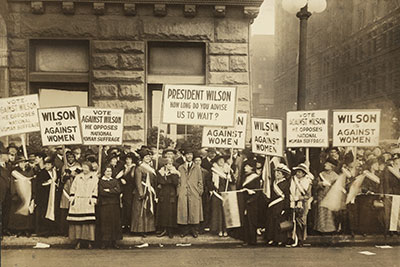
Alice returned to the United States in 1910 and spent the next several years building what would become the National Woman’s Party (NWP). In January 1917, the NWP launched an audacious campaign: the first-ever sustained political protest at the White House gates. Six days a week, women dressed in white — known as the Silent Sentinels — stood in silence holding banners that quoted President Woodrow Wilson’s own speeches back at him. One banner read: “We shall fight for the things which we have always held nearest our hearts — for democracy, for the right of those who submit to authority to have a voice in their own governments.”
Wilson had said those words. About the war in Europe. About other people’s freedom. The Sentinels wanted to know when he intended to apply them at home.
When the United States entered World War I in April 1917, the public mood shifted. The picketers were now viewed by many as unpatriotic. In June 1917, authorities began arresting the women on the absurd charge of “obstructing traffic.” Over the following months, more than 150 suffragists were arrested, convicted, and imprisoned — most at the Occoquan Workhouse in Virginia, others at the District of Columbia Jail. Alice deliberately sought the longest sentence available: seven months, beginning October 22, 1917.
The Hunger Strike Begins
The conditions at the District Jail were deliberately punitive. Sanitation was poor. Food was infested. There was no recognition of political prisoner status. On November 5, 1917, Alice began her hunger strike. Her stated purpose was clear: to demand that she and her fellow suffragists be treated as political prisoners, as was standard practice in every other civilized nation. Her fellow prisoner Rose Winslow began her strike the same day.
By November 8, both women were being force-fed three times a day.
The process was as brutal as it sounds. Guards and medical staff held the women down while doctors inserted a rubber tube through the nose or down the throat. Liquid food — in Alice’s case, raw eggs — was forced through the tube into the stomach. Women frequently choked, gagged, and vomited. The procedure damaged teeth, gums, and throat tissue. Mary Leigh, a British suffragette who had undergone force-feeding in 1909, described it this way: “The sensation is most painful — the drums of the ear seem to be bursting, a horrible pain in the throat and the breast.”
Alice was not broken. She continued the strike.
The Psychiatric Ward: A Weapon of Discreditation
Prison authorities escalated. If they could not make Alice eat, perhaps they could make her mad — or at least make the world believe she was. Her doctor, a man named Gannon, informed her that if she persisted in hunger-striking he would “write a prescription” to have her taken to the psychopathic ward and fed forcibly there.
She was placed on a stretcher and taken.
For one week, Alice was confined to the psychiatric ward of the District Jail. Prison officials checked on her once an hour through the night, flashing an electric light into her face each time. They weren’t just “observing” her; they were using sleep deprivation, a known torture technique known as state-sanctioned sleep deprivation. Her windows were nailed shut — the government literally depriving her of air. She was held in solitary confinement with iron-barred doors. The stated purpose was observation; the real purpose was intimidation and the hope that if they could brand the leader of the suffrage movement as mentally unstable, they could discredit the entire movement.
It failed. Catastrophically.
Alice smuggled notes out of the ward. Her attorney, Dudley Field Malone — a Wilson appointee so outraged by the women’s treatment that he had already resigned his government post in solidarity — obtained her release on a writ of habeas corpus. Prison officials admitted they had no doubts about her sanity. The psychiatric confinement, exposed to the press, looked exactly like what it was: a desperate government using the machinery of mental illness to silence a woman who was winning.
The Night of Terror
Meanwhile, at the Occoquan Workhouse, things were about to get worse. On the night of November 14, 1917, prison superintendent William H. Whittaker ordered approximately 40 guards to “teach the women a lesson.” What followed became known in history as the Night of Terror.
Guards dragged women down hallways and threw them into dark cells. Lucy Burns had her hands shackled above her head and was forced to stand all night. Dorothy Day — later founder of the Catholic Worker Movement — was slammed down over the arm of an iron bench twice. Dora Lewis was thrown so violently that she lost consciousness after her head struck an iron bed. Alice Cosu, witnessing the assault on Lewis, suffered a heart attack and was denied medical attention until the following morning.
The women were not rioting. They were demanding to be treated as political prisoners.
The Men Who Wept and Joined Them
The suffering of Alice and her fellow suffragists did not occur in a vacuum. It landed in the hearts of specific men — men with power, men with conscience, men who had been unmoved by argument but found themselves unable to look away from what was being done in their name. The hunger strike was not merely a tactic of endurance; it was a moral mirror. When a woman chooses starvation over surrender, she forces every man in proximity to decide what kind of man he is. Some chose wrong. But enough chose right to change history.
The first man to break was one of their own. Dudley Field Malone was a Wilson administration insider — the Collector of the Port of New York, a presidential confidant, a man with everything to lose. When he saw what was happening to Alice and the other suffrage prisoners, he resigned his government post in protest and became Alice’s attorney. He was not asked to do this. He was not politically advantaged by doing it. He did it because what he saw was wrong and he was a man who could not pretend otherwise. He obtained Alice’s release from the psychiatric ward through a writ of habeas corpus. That a Wilson appointee turned on Wilson over the treatment of these women was a signal to the President that the political ground was shifting — and that men of good conscience were watching.
Then came the press — overwhelmingly male editors and journalists who, once the stories escaped the prison walls, could not contain their outrage. Reports of the Night of Terror, of Alice’s psychiatric confinement, of Lucy Burns shackled with her hands above her head all night, of Dorothy Day slammed over an iron bench — these stories ran in newspapers read by men across the country. Men who had been broadly indifferent to women’s suffrage found themselves reading accounts of American women being tortured by government agents for the crime of holding signs. The hunger strike had made the invisible visible. The force-feedings, the sleep deprivation, the midnight light shone into a starving woman’s face — these images did what decades of polite lobbying had not. They created moral emergency in men who had not previously felt one.
And then Wilson himself moved. The President who had waved at the Silent Sentinels from his limousine window, who had publicly patronized the movement for years, who had sent these women to prison on a traffic charge — he was appalled by what he found had been done in his administration’s name. The hunger strikes disgusted him. The Night of Terror disgusted him. His own daughter, Jessie Woodrow Wilson Sayre, was a suffragist, and her father’s conscience was not entirely dead. By January 1918, Wilson stood before Congress and endorsed the federal suffrage amendment for the first time. The man who had been the wall became the door. That is what the hunger strikes accomplished: they broke through the political calculation and reached the moral core of the men who held the power — and some of those men, confronted finally with what they could not un-see, did the right thing.
The Tide Turns
News of Alice’s psychiatric confinement and the Night of Terror leaked out of the prison walls. The press erupted. Public outrage was swift and enormous. The NWP organized large picket protests specifically addressing the treatment of Alice and other suffrage prisoners. Thirty-one additional picketers were arrested.
The government blinked.
In late November 1917, under massive public pressure, federal authorities released Alice, Burns, and all remaining suffrage prisoners. When Alice emerged from the jail — pale, thin, having been force-fed three times a day for weeks — she issued a statement on the steps of the National Woman’s Party headquarters that has become one of the most quietly devastating sentences in American political history:
“It was shocking that a government of men could look with such extreme contempt on a movement that was asking nothing except such a simple little thing as the right to vote.”
In early 1918, the D.C. Court of Appeals ruled that the women had been illegally arrested, convicted, and imprisoned from the start. In January 1918, President Wilson — who had refused for years to endorse women’s suffrage — publicly announced his support for the federal suffrage amendment, citing the role women had played in the war effort. The body politic had moved. Within months he was actively calling on Congress to act.
Congress passed the 19th Amendment in June 1919. It was ratified on August 18, 1920. American women had the right to vote.
The Body That Would Not Yield
Alice lived to 92. She spent the remaining decades of her life fighting for the Equal Rights Amendment, which she authored in 1923 and which still, at this writing, has not been fully ratified. She never stopped. The woman who was carried out of a British prison with permanent digestive damage in 1909, who was strapped down and tube-fed in 1917, who was sent to a psychiatric ward to be broken and emerged instead unbreakable — she kept going.
What Alice understood, and what her body demonstrated at the cost of her health and freedom, is that political power is not only exercised through legislation and elections. Sometimes it is exercised through the willingness to make your own suffering undeniable. To force a government to look at what it is doing. To refuse, in your bones and your gut and your starved and aching body, to pretend that what is happening is acceptable.
The tube went down her throat. The right to vote came out.
Courage in women is often mistaken for insanity.
— Alice Paul
Sylvia Pankhurst: The Rebel Who Refused to Become Smaller Than She Was
The Woman:
What kind of woman walks away from power, prestige, family approval, and public admiration because her conscience will not let her do otherwise?
Not a woman seeking conflict. Not a woman seeking attention. A woman who has decided that truth matters more than comfort and that dignity belongs to everyone — not merely the fortunate, not merely the politically convenient, not merely the women whose suffering is easy for polite society to acknowledge.
Most people know the Pankhurst name. Few know Sylvia Pankhurst. Yet her life represents one of the most extraordinary examples of courage, service, independence, and moral conviction in modern history. She was force-fed more times than any other suffragette. She was expelled from the movement her own family led. She built clinics and nurseries and cost-price restaurants for families the movement had largely forgotten. She opposed a world war when opposing it was dangerous. She spent her final years in Africa fighting for a people most of her contemporaries barely registered as mattering.
She never stopped. She never shrank. She never chose comfort over conscience. This is the story of the woman who refused to become smaller than she was.
Her Story:
Estelle Sylvia Pankhurst was born in Manchester on May 5, 1882, the second daughter of Richard Pankhurst — a barrister and social reformer — and Emmeline Pankhurst, who would become the most famous suffragette in British history. She grew up inside one of the most politically charged households in England, where justice was discussed at the dinner table and the cause of women’s rights was not an abstraction but the animating purpose of family life.
She was intelligent, artistic, and deeply sensitive to injustice in its specific and personal forms. She studied at Manchester School of Art on a scholarship before gaining entrance to the Royal College of Art in London, where she trained from 1904 to 1906. She was genuinely gifted — her artwork eventually gave the suffragette campaign its distinctive visual identity. She designed the WSPU’s logo, posters, banners, and the famous Holloway Brooch, awarded to suffragettes who were imprisoned for the cause.
Before she became a symbol, she was a daughter, an artist, a thinker, and a dreamer — a woman who believed that the imagination and the conscience are not separate faculties but deeply connected ones, and that the work of art and the work of justice are ultimately the same work.
The Woman Who Chose Conscience Over Approval
The Women’s Social and Political Union, founded by Emmeline Pankhurst in 1903, became the most militant and most visible suffragette organization in Britain. Sylvia was one of its most dedicated members through the early years — arrested for the first time in 1906, imprisoned repeatedly, earning her Hunger Strike Medal for Valour. She wrote the movement’s history in 1911: The Suffragette: The History of the Women’s Militant Suffrage Movement.
But tensions were developing that would eventually require Sylvia to make a choice that many people never manage to make: the choice of principle over family loyalty.
Emmeline and Christabel Pankhurst’s WSPU had narrowed its focus to securing the vote for women on existing property-owning terms — which meant, in practice, securing the vote for middle- and upper-class women first. Working-class women, who had no property, would wait. The movement had also grown increasingly autocratic under Christabel’s leadership, brooking little internal dissent. And it had drifted toward a form of militant action — window-smashing, arson — that Sylvia believed was counterproductive and alienating to the broader public whose support the movement needed.
Sylvia disagreed. Not casually. Not as a bid for attention. She disagreed because she had been working in the East End of London, among the working-class women whose lives the movement claimed to represent and whose reality it was choosing to defer. She had seen what poverty actually looked like from the inside. She could not, in good conscience, subordinate those women’s claims to the political convenience of a narrower campaign.
In January 1914, she was expelled from the WSPU. Her mother, by that point, had largely stopped speaking to her.
It is often easier to oppose enemies than to disappoint the people we love. Sylvia chose principle anyway — and in doing so became something the original movement had not quite managed to be: genuinely radical in her commitment to justice for all women rather than for the most politically convenient ones.
The Suffragette Who Paid the Price
The account of what Sylvia Pankhurst endured in prison deserves to be stated plainly. She was arrested thirteen to fifteen times — accounts vary slightly — and subjected to force-feeding during multiple imprisonments. According to biographer Rachel Holmes, Sylvia went on hunger strike and was force-fed more times than any other suffragette. Her own mother hunger-struck but was never force-fed. Christabel, directing the movement from Paris, was not required to hunger-strike at all.
Force-feeding, as described by Sylvia and by Keir Hardie — the Labour Party leader who loved her and who became one of its most vocal critics — involved women being held down by multiple prison officers while doctors forced a rubber tube through the nose or down the throat. Liquid food was then pumped into the stomach. Women frequently choked, vomited, and sustained damage to teeth, gums, and throat tissue. In June 1914, desperately weakened after a hunger-and-thirst strike, Sylvia had herself carried to the steps of the Houses of Parliament, where she pledged to remain without food or water until the government made some commitment toward women’s suffrage.
She did not merely advocate for sacrifice. She endured it — repeatedly, specifically, in her own body — without the protection of her family’s famous name or the organizational support that might have shielded a more politically useful figure.
The Woman Who Served Real People
After the vote was partially won in 1918 — and fully won, for all women over twenty-one, in 1928 — many suffragettes considered the work complete. Sylvia did not. She had been building something in the East End of London throughout the war years that went considerably beyond political advocacy.
The East London Federation of Suffragettes, which she founded and led, had established cost-price restaurants to feed families struggling through wartime deprivation. It had created nurseries for children of working mothers. It had organized clinics. It had published the Workers’ Dreadnought, a newspaper that gave voice to perspectives the mainstream press declined to carry. It had built the kind of community infrastructure that transformed abstract justice into concrete daily support for actual human beings whose names she knew and whose lives she had entered.
This is the dimension of Sylvia’s legacy that tends to receive the least attention, perhaps because it is less dramatic than imprisonment and force-feeding. But it is, in some respects, the most revealing thing about her. She did not stop at fighting for rights. She spent years building the conditions under which rights could actually be exercised — by people who had been too hungry, too exhausted, and too unsupported to benefit from abstract political victories.
The Rebel Who Would Not Stay in One Box
The vote achieved, Sylvia moved on. This is not a criticism — it is a description of what genuine moral commitment looks like when it is not organized around a single cause but around a consistent principle: that human dignity is not divisible, and that its defense requires following the need rather than the applause.
She opposed the First World War when opposing it was unpopular and dangerous. She opposed fascism through the 1930s, when much of Europe was still finding reasons to accommodate it. When Benito Mussolini’s Italy invaded Ethiopia in 1935, Sylvia began a campaign of advocacy for the Ethiopian people that would eventually consume the last chapter of her life. She published the New Times and Ethiopia News, keeping international attention on the occupation when most of the world had moved on. She moved to Ethiopia in 1956 at the invitation of Emperor Haile Selassie, and she died there on September 27, 1960, in Addis Ababa.
Many activists stop when their cause succeeds. Some stop when the cause becomes unfashionable. Sylvia never stopped. She simply followed the conscience that had always been her actual compass — and the compass kept pointing toward the people whose dignity was most at risk of being overlooked.
What Made Sylvia Different
She was not merely brave. Many people are brave when the stakes are clear and the audience is watching. Sylvia was brave in the less celebrated ways — the ways that cost social belonging, family approval, political credibility, and the comfort of being on the winning side of the argument her own movement was having.
She was fiercely independent without being cold. The work in the East End was not theoretical solidarity — it was years of actual presence among actual families whose lives she was actually trying to improve. She combined the intellectual rigor of someone who could produc
She was loyal to conscience in a way that is genuinely rare, because conscience is a more demanding master than ideology or family or social belonging. Ideology tells you what to think. Conscience asks you to look clearly at what is actually in front of you and respond to it honestly, regardless of whether the honest response is convenient.
She was, in the truest sense, free — and freedom of that quality tends to look, from the outside, like trouble.
Why She Still Matters
The questions Sylvia’s life raises do not grow old. What happens when we refuse to betray our conscience — when we hold to what we actually know to be true even when the social cost of holding it becomes significant? What happens when we stop shrinking to fit other people’s expectations of who we are supposed to be?
Can one person remain both compassionate and fiercely independent? Sylvia’s life answers yes — not as a theoretical possibility but as a lived demonstration across more than five decades of consistent, costly, genuinely principled engagement with the world.
She belongs in this book not because she suffered. Not because she was imprisoned. Not because she was famous. She belongs because she spent her life refusing to become smaller than truth, conscience, service, and love required her to be.
The world asked Sylvia to choose between belonging and conviction. She chose conviction — and in doing so became impossible to forget.
Freedom cannot be won by dividing it; it must be won by achieving it together.
– Sylvia Pankhurst
The Iron Will of Ireland: Mary MacSwiney and the Fight for Freedom
The Woman:
Mary MacSwiney is often remembered as the sister of Terence MacSwiney, the Lord Mayor of Cork who died after a seventy-four-day hunger strike in Brixton Prison in 1920. Yet Mary herself became one of the most formidable women in Ireland’s struggle for independence—a woman whose moral force, emotional endurance, and unwavering convictions made governments fear what her death might symbolize.
Before she became a hunger striker herself, Mary endured the unimaginable experience of watching her beloved brother slowly die for what he believed in. Many people would have emerged from such grief shattered or broken. Instead, something in Mary hardened into conviction. The sorrow entered her body and became a form of embodied resistance so profound that she herself would later undertake hunger strikes rather than betray her conscience. Yet despite her extraordinary will, Mary was not cold, cruel, or emotionally numb. Her strength carried a deeply human quality. She understood suffering, loyalty, love, sacrifice, and the terrible cost of conviction. Her greatness emerged not from the absence of pain, but from her refusal to surrender the integrity of her soul even when doing so demanded enormous personal sacrifice.
What is sometimes lost in the political history is who Mary actually was before and beneath the symbol. Unbeknownst to many, she had only one foot. An infection in childhood had required an amputation, and she walked through every parliamentary chamber, every prison visit, every confrontation with the British government, every day of her two hunger strikes on one foot and a prosthetic — a fact she never mentioned, apparently, because it simply did not interest her as much as everything else.
At one point, she had almost become a nun, entering a noviciate with the Oblates of St Benedict as a young woman before her mother’s death in 1904 called her home to Cork to head the family household, and she exchanged one form of devoted life for another without apparent grief at the transition. She obtained her teaching diploma at Cambridge University, where women were not normally admitted, on a borrowed loan — because she had no money of her own — and she taught in English convent schools until Irish independence became the thing that mattered most. When British soldiers came for her in 1916, they walked into her classroom while she was teaching children and arrested her in front of her students. She was fired from her post for her politics. She responded by opening a school in her own parlor — in the house she shared with her sister Annie at 4 Belgrave Place in Cork — and she taught there until the day she died at sixty-nine.
When her brother Terence’s widow fell apart after his death and could no longer care for their daughter Máire, Mary traveled to Germany, where the child had been sent, and brought her home through a court case she fought and won. She raised the girl in her own school. She taught her herself. This is the woman who undertook two hunger strikes rather than betray her conscience — not a monument, but a teacher with one foot and a borrowed loan and a parlor full of children and an absolute refusal to be smaller than she was.
Her Story:
Mary became part of one of the most psychologically and symbolically powerful lineages of embodied resistance in modern history. Her life reveals what can happen when grief, conviction, love, nationalism, conscience, and personal sacrifice fuse so completely that the human body itself becomes a moral instrument. Although her brother Terence MacSwiney is often remembered more prominently in historical discussions because of his death during a seventy-four-day hunger strike in 1920, Mary’s own actions demonstrate that she was far more than the sister of a martyr. She became a formidable force in her own right—one whose endurance and refusal carried enormous symbolic weight during Ireland’s struggle for independence.
Mary was born in Cork, Ireland, in 1872 into a politically engaged family deeply involved in Irish nationalism and cultural revival movements. Like many members of the MacSwiney family, she believed passionately in Irish self-determination. The late nineteenth and early twentieth centuries in Ireland were periods of intense political upheaval, with growing resistance to British rule and increasing demands for Irish sovereignty. Yet Mary’s contribution to this struggle was not limited to political rhetoric or organizational work. Over time, she became associated with a far deeper and more psychologically intense form of resistance: the willingness to suffer physically rather than betray deeply held convictions.
To understand Mary’s significance, one must first understand the impact of her brother Terence’s death. Terence served as Lord Mayor of Cork and was arrested by British authorities during the Irish War of Independence. While imprisoned in Brixton Prison in London, he began a hunger strike that would ultimately last seventy-four days before his death in October 1920. His suffering attracted international attention and generated enormous sympathy for the Irish cause. Around the world, newspapers reported on his deterioration, his resolve, and the extraordinary endurance of a man who chose starvation rather than submission.
But for Mary, Terence’s death was not merely a political event or historical symbol. It was personal. She watched her brother slowly die. She witnessed the emotional and physical consequences of prolonged fasting and the terrible collision between conviction and mortality. For many people, such an experience would have become a warning against further sacrifice. For Mary MacSwiney, it became something else entirely: embodied grief transformed into somatic conviction.
That transformation is one of the most psychologically striking aspects of her story. Mary did not merely inherit her brother’s political ideals intellectually. She absorbed the emotional and bodily reality of his sacrifice into her own nervous system. In later years, she herself undertook hunger strikes—twice—lasting twenty-three days and thirty-four days respectively. In both cases, authorities released her rather than risk the public outrage and moral catastrophe that might follow her death.
This creates one of the most fascinating paradoxes in the history of female hunger strikers. Historically, governments often proved more willing to allow male hunger strikers to die than female hunger strikers. This was not necessarily because women suffered less or possessed weaker convictions. In many cases, the opposite was true. Female hunger strikers often wielded extraordinary leverage precisely because governments feared the public horror associated with visibly destroying female bodies. The suffragettes themselves understood this dynamic and strategically weaponized it. Their suffering exposed the contradictions of societies that claimed to value women while simultaneously brutalizing them when they demanded dignity, rights, or political agency.
Mary’s hunger strikes existed within this larger cultural and psychological tension. British and Irish authorities understood the symbolic implications of allowing another MacSwiney to die. The image of a woman following her brother into martyrdom carried the potential to intensify outrage, deepen sympathy for Irish nationalism, and further undermine the legitimacy of state power. As a result, the threat of Mary’s death itself became politically potent.
Yet it would be a mistake to interpret her survival as evidence that her sacrifice mattered less. In some ways, the opposite may be true. Mary’s hunger strikes reveal the terrifying power of unresolved possibility. She became a living continuation of the MacSwiney lineage rather than its tragic conclusion. Her body itself carried historical memory forward.
Mary and her brother Terence established something that would echo through generations of Irish resistance: proof that the human body itself could become a political and moral instrument powerful enough to challenge an empire. Decades later, the 1981 H-Block hunger strikers—Bobby Sands, Francis Hughes, Raymond McCreesh, Patsy O’Hara, Joe McDonnell, Martin Hurson, Kevin Lynch, Kieran Doherty, Thomas McElwee, and Michael Devine—would follow a path their suffering helped carve into history.
The psychological power of listing names individually rather than reducing them to statistics should not be underestimated. A number remains abstract. Names become human. Each name evokes a body, a face, a family, a history, and a life that can never be repeated. Readers do not merely process such lists intellectually; they feel them physically. The accumulation lands in the nervous system. This embodied reaction is central to understanding why hunger strikes exert such unusual emotional force. They transform political struggle into intimate human confrontation.
What made Mary particularly compelling was the combination of severity and restraint within her personality. She possessed extraordinary determination without theatrics. Her suffering did not appear performative. Instead, it carried the atmosphere of someone who had crossed an internal threshold beyond which compromise no longer felt morally possible. That quiet intensity often proves more psychologically haunting than overt displays of aggression.
Her story also reveals something profound about the relationship between grief and identity. Modern culture often treats grief as something temporary to be processed and eventually resolved. But for certain individuals, grief becomes formative. It reorganizes the structure of the self. In Mary’s case, the death of her brother appears to have deepened rather than weakened her commitment. The pain did not extinguish conviction; it fused with it.
This dynamic helps explain why hunger strikers throughout history continue to exert such enduring fascination. Their actions force observers to confront difficult questions about conscience, suffering, embodiment, and meaning. What does it mean when someone values an internal principle more than physical survival? What happens psychologically when the body itself becomes the final remaining instrument of resistance? And why do such acts continue to move people emotionally across generations and political boundaries?
Mary’s life does not provide easy answers to these questions. Nor should it. Hunger strikes occupy morally and psychologically complex territory. They involve suffering, sacrifice, political struggle, and human vulnerability in ways that resist simplistic interpretation. Yet precisely because of this complexity, figures like Mary continue to resonate.
She represents a form of feminine power that modern culture often struggles to categorize. She was not powerful because she abandoned tenderness or transformed herself into a caricature of hardness. Nor was her strength dependent upon physical domination. Instead, her power emerged through moral endurance, symbolic presence, emotional gravity, and an almost unbearable level of conviction.
In this sense, Mary’s story transcends Irish political history. It becomes a meditation on what happens when a human being decides there are truths more important than comfort, safety, or social approval. Her life reminds us that dignity is not merely an abstract concept or intellectual belief. It is something embodied. Something lived. Something that, in rare moments of extraordinary courage, individuals become willing to suffer for rather than betray.
No physical victory can compensate for a spiritual surrender.
— Mary MacSwiney
The Three Women
You have just spent time with three women who, across different centuries and different continents and radically different circumstances, arrived at the same essential truth. Alice confronted power. Sylvia challenged it. Mary quietly outlasted it. Yet all three discovered that there is a self inside every woman that cannot be negotiated away, cannot be imprisoned, cannot be force-fed into silence, or legislated out of existence.
The question this exercise now asks of you is not whether you can match what these women endured — you cannot, and you are not being asked to. The question is whether you are willing to sit quietly with a skipped meal and a few honest pages and consider that the same interior grace exists in you. Not because you have suffered enough to earn it. Not because you have been accommodating enough or strong enough or self-sacrificing enough to deserve it. But because you are a woman — because you were born into this world already carrying it — and because no amount of conditioning, disappointment, or accumulated evidence to the contrary was ever supposed to make you forget that. That is what this exercise is actually for.
The Magnificent Protocol™
Here is the exercise step-by-step.
Tools You Will Need
- Computer
- Printer
- Printer paper
- Tape
- Notebook or paper
- Pen or pencil
- A warm blanket
Step One
Google the following three women and print out photographs of all three:
Alice Paul
Mary MacSwiney
Sylvia Pankhurst
Step Two
Tape all three of the women’s photographs onto a wall in your home that you naturally see throughout the day—your bedroom, kitchen, hallway, or living room.
Step Three
Leave the photographs on your wall for seven days.
During this time, look at your schedule and choose a day where you can safely skip either lunch or dinner. Make sure the meal that you choose to skip is a meal you normally have on a regular basis.
Note: If you have health problems discuss with your doctor which meal you can safely skip. Only if they are concerned with your skipping a meal entirely should you ask them if you can delay the meal by a few hours.
Step Four
On the day you skip your meal, you must remain at home to complete the exercise.
Before you begin, stand quietly in front of the photographs taped to your wall. Look at each person carefully.
Remember that every one of them willingly endured discomfort, sacrifice, uncertainty, or suffering because they believed something mattered more than their immediate comfort.
Step Five
As you skip your meal, notice carefully when hunger begins appearing in your body.
Where do you feel it?
You may discover that hunger is experienced in places beyond the stomach. You may feel it in your chest, throat, jaw, shoulders, emotions, thoughts, or nervous system.
Write down where you feel hunger in your body.
Then write down how the hunger affects your emotions, thoughts, attention, memories, and sense of self.
Step Six
Now sit quietly with the following statement:
All three people on your wall were human beings who willingly endured profound sacrifice for people they loved and for what they believed in.
Now write:
“I am every bit as worthy of all the beautiful things life has to offer, most importantly a devoted loving partner who cherishes every part of me.
Because it is true. I deserve this. I am worthy.”
Write down how this statement makes you feel.
Step Seven
Take a large throw blanket or small bed blanket and throw it in the dryer for 10 minutes. Then sit either in bed or your most comfortable chair with the blanket wrapped around you. Close your eyes. As you sit, feel the warmth of the blanket wrapped around you feel the arms of your beloved embracing you, caressing you. And think about how you deserve all of this love, warmth and devotion.
Sit for as long as you are comfortable.
Anchors: A Final Exercise Note
Repeat any step of this exercise or all steps whenever you feel the need. All the steps have anchors in them. Anchors are psychological tools that re-attach to the original experience. For example, do Step Four and skip a meal when you want to feel your power and worthiness. Or do Step Seven in this last step and wrap yourself in a blanket when you want to feel embraced and loved. I invite you to create whatever anchors you need to create as many bridges and paths as you need.
I have completed this several times over the years. Every time I do it, I’m moved more deeply. It has changed me and it’s my hope that it will help you discover something beautiful about yourself as well.
This is the end of the exercise…
and the beginning of you believing that you deserve the best that life and love have to offer.
Integration and Re-Entry After The Magnificent Protocol
The women you have just encountered were not emotionally numb people. They were not cold monuments carved from stone. They were human beings with bodies, hearts, fears, longings, tenderness, relationships, memories, grief, and vulnerability. They felt exhaustion. They felt loneliness. They felt hope, despair, devotion, love, outrage, courage, and spiritual conviction. Part of what makes these stories emotionally powerful is that they force us to confront the reality that extraordinary strength can exist alongside extraordinary sensitivity. In fact, the two are often intertwined.
Because of this, some readers may find themselves unexpectedly affected after completing these exercises. You may notice lingering sadness, emotional openness, vivid dreams, tears, humility, tenderness, existential reflection, nervous-system sensitivity, or a heightened awareness of both suffering and beauty in ordinary life. You may feel emotionally expanded in ways that are difficult to explain logically. Some readers report feeling more alive, more emotionally porous, more compassionate, more grateful, or more aware of the fragility and preciousness of human existence itself. Others may temporarily feel psychologically disoriented, emotionally raw, spiritually reflective, or deeply contemplative. None of these responses necessarily mean something is wrong. Sometimes emotionally immersive experiences continue unfolding internally long after the exercise itself has ended.
It is important to understand that the purpose of this Protocol was never to glorify suffering or encourage self-sacrifice as a measure of human worth. The goal was not to convince you that you must become extraordinary by destroying yourself. The goal was to help you encounter qualities that modern life often suppresses or numbs: dignity, conscience, emotional courage, devotion, tenderness, integrity, reverence, and the fierce beauty of a human being refusing to abandon their deepest truths. These women were not magnificent because they suffered. They were magnificent because they remained profoundly human while enduring suffering.
If you find yourself deeply affected by this work, please resist the temptation to immediately interpret every emotion as a spiritual revelation or demand for dramatic change. Human beings sometimes need time to metabolize emotionally significant experiences. Allow yourself to move slowly. Rest. Eat nourishing food. Reconnect with your body. Spend time in nature. Listen to music. Watch something funny. Sit with people who make you feel emotionally safe. Return to ordinary routines and gentle pleasures. Integration often happens not during moments of intensity, but during the quiet return to daily life afterward.
You may also find it helpful to talk with a trusted therapist, counselor, mentor, spiritual director, sponsor, healer, pastor, friend, or emotionally grounded support person about your experience. Some readers may discover that these exercises touch older grief, questions about identity, unresolved longing, spiritual hunger, relationship wounds, self-worth struggles, or deeply buried emotional material. There is no shame whatsoever in seeking support while processing emotionally meaningful experiences. Human beings are not designed to navigate every transformation alone.
Please remember that you are allowed to pause. You are allowed to step back. You are allowed to revisit these exercises later or decide certain aspects are not right for you. Emotional intensity is not proof of spiritual superiority, moral advancement, enlightenment, or greater worthiness. Different nervous systems respond differently to symbolic and emotionally charged material. Some readers will feel profoundly moved. Others may feel relatively unaffected. Some may feel inspired while others feel unsettled. There is no single “correct” response to this work.
One of the more unexpected effects some readers report after emotionally immersive exercises is a sudden shift in scale and perspective. You may feel humbled by the realization that immense courage, devotion, conscience, and emotional endurance have existed within ordinary human beings throughout history. Sometimes this realization creates a strange paradoxical feeling of both smallness and connection at the same time. If this occurs, try not to collapse into self-erasure. Healthy humility does not require you to become emotionally microscopic. The point is not to conclude, “I am nothing.” The point is to recognize that beauty, courage, tenderness, dignity, love, and sacrifice belong to humanity itself rather than only to mythical heroes or unreachable historical figures.
You may also notice changes in how you perceive relationships after completing this Protocol. Some readers find themselves less willing to tolerate emotional starvation, indifference, cruelty, dishonesty, emotional numbness, manipulation, contempt, or relationships that require continual self-abandonment. Others experience a heightened longing for tenderness, emotional safety, devotion, reverence, intimacy, and fully embodied love. You may discover that your standards begin changing quietly from the inside out. Allow these realizations to unfold gradually rather than forcing immediate decisions or dramatic conclusions.
Remember, the goal here is to strengthen the belief that you are in every way worthy of great love.
Carry what nourishes your spirit forward gently. Leave behind what does not serve you. Stay connected to your body, your relationships, your support systems, your spirituality, your community, your laughter, your tenderness, and your ordinary daily life. And above all, remember this: the qualities that moved you in these women were never separate from humanity itself. They were reflections of what human beings are capable of becoming when conscience, love, dignity, and courage remain stronger than fear.
Wrapping Up and Returning to Yourself
What you just moved through was never just about history. It was an encounter with three women who carried extraordinary moral force inside ordinary human minds and bodies. Women who felt fear, loneliness, longing, grief, tenderness, exhaustion, and love — yet still refused to betray the deepest truths within themselves.
For a little while, you stepped outside the constant noise and demands of your life. You allowed yourself to experience emptiness instead of immediately filling it. You sat beside stories of women who transformed their own bodies into instruments of conscience, compassion, resistance, and sacred resolve. And somewhere in the middle of that encounter, you were invited to recognize something profoundly important:
The same capacity for grace, courage, devotion, and inner sovereignty lives within you too.
This chapter was never meant to glorify pain. It was meant to awaken remembrance. To help you feel, not merely understand intellectually, that there is a part of you worthy of exquisite care, honesty, passion, protection, adoration, emotional safety, and wholehearted love.
When a woman truly begins to reconnect with that part of herself, her entire relationship to life begins to reorganize. She becomes less willing to negotiate away pieces of her soul in exchange for approval.
Less willing to shrink herself to avoid making others uncomfortable.
Less willing to confuse attention for devotion or longing for love.
Less willing to remain inside connections that starve her spirit while asking her to call it maturity.
At the same time, something softer and more radiant often begins to emerge.
A deeper trust in intuition.
A greater capacity for intimacy.
A quieter but more unshakable confidence.
A willingness to receive love without apologizing for needing it.
A desire to protect the tenderness of the heart rather than abandon it in order to survive.
You do not need to chain yourself to a movement, endure imprisonment, or fast for years in order to embody these qualities. Human life offers countless opportunities to live from this deeper place:
speaking truthfully,
honoring your instincts,
remaining emotionally present,
allowing yourself to be cherished,
walking away from cruelty,
choosing relationships that nourish rather than diminish you,
and refusing to participate in your own emotional disappearance.
Perhaps some hidden part of you already recognizes this feeling.
Perhaps something ancient inside you has begun waking up again.
If it has, do not rush to abandon it when you return to ordinary life.
Protect it. Feed it. Trust it.
Carry it into the way you speak, the way you love, the way you touch, the way you choose, and the way you allow yourself to be seen.
There is nothing weak about a woman who remains openhearted while standing fully inside her own dignity. There is something magnificent about her.
And may you never again settle for a love that cannot recognize it.
Randi Fredricks, Ph.D.
Medical Disclaimer: This exercise is educational in nature and is not intended as medical or psychological treatment. Consult your physician before fasting, especially if you have any medical or mental health condition.
Companion Song:
— Sensation, The Who 1969
The Magnificent Protocol™ is a trademark of Randi Fredricks.
This article is inspired by Randi Fredricks, Ph.D.’s book Magnificent Men: How Men Are Undervalued and How Worshipping and Being Worshipped Can Bring You The Hot and Holy Love You Desire, exploring the restoration of men’s dignity and worth, the sacred and sensual dimensions of intimacy, and hot and holy love.
References
American University Magazine. (2020). Alice Paul and the Petticoat Army. https://www.american.edu/magazine/article/alice-paul-and-the-petticoat-army.cfm
Baker, J. H. (2011). Sisters: The lives of America’s suffragists. Hill and Wang.
Beresford, D. (1987). Ten men dead: The story of the 1981 Irish hunger strike. Atlantic Monthly Press.
British Heritage. (n.d.). Sylvia Pankhurst—Suffrage and suffragette. https://britishheritage.org/sylvia-pankhurst-suffrage-and-suffragette
Davis, M. (1999). Sylvia Pankhurst: A life in radical politics. Pluto Press.
Ford, L. G. (1991). Iron-jawed angels: The suffrage militancy of the National Woman’s Party, 1912–1920. University Press of America.
History.com Editors. (2019, March 4). The Night of Terror: When suffragists were imprisoned and tortured in 1917. HISTORY. https://www.history.com/articles/night-terror-brutality-suffragists-19th-amendment
Historic Newspapers. (n.d.). Sylvia Pankhurst legacy and accomplishments. https://www.historic-newspapers.com/blogs/article/sylvia-pankhurst-legacy
Holmes, R. (2020). Sylvia Pankhurst: Natural born rebel. Bloomsbury Publishing.
Humanist Heritage. (n.d.). Sylvia Pankhurst (1882–1960). https://heritage.humanists.uk/sylvia-pankhurst/
Library of Congress. (n.d.). Historical timeline of the National Woman’s Party, 1917. Women of Protest: Photographs from the Records of the National Woman’s Party. https://www.loc.gov/collections/women-of-protest/articles-and-essays/historial-timeline-of-the-national-womans-party/1917/
London Museum. (n.d.). Sylvia Pankhurst: Suffragette, artist, activist. https://www.londonmuseum.org.uk/collections/london-stories/sylvia-pankhurst-suffragette-artist-and-activist
MacSwiney, M. (1932). History of the Irish Republic. Irish Press.
Maume, P. (2009). MacSwiney, Mary. In Dictionary of Irish Biography. Royal Irish Academy.
NCBI Bookshelf. (2016, August 26). ‘An experience much worse than rape’: The end of force-feeding? In A history of force feeding. https://ncbi.nlm.nih.gov/books/NBK385290/
O’Malley, P. (1990). Biting at the grave: The Irish hunger strikes and the politics of despair. Beacon Press.
Pankhurst, S. (1911). The suffragette: The history of the women’s militant suffrage movement, 1905–1910. Sturgis & Walton.
Pankhurst, S. (1932). The home front: A mirror to life in England during the World War. Hutchinson.
Pankhurst, S. (1935). The life of Emmeline Pankhurst. T. Werner Laurie.
Spartacus Educational. (n.d.). Sylvia Pankhurst. https://spartacus-educational.com/WpankhurstS.htm
Stevens, D. (1920). Jailed for freedom: American women win the vote. Boni and Liveright.
Townshend, C. (2014). The republic: The fight for Irish independence, 1918–1923. Penguin Books.
Turning Point Suffragist Memorial. (2017, November 18). Alice Paul’s note from the psychopathic ward. https://suffragistmemorial.org/november-18-1917/
Author Bio
Randi Fredricks, Ph.D. is a best-selling author and provocateur whose work explores love, relationships, sexuality, spirituality, and the magnificent complexity of being human. For more than three decades, she has explored what helps people connect more deeply, love more courageously, and create extraordinary relationships. Her writing blends psychology, spirituality, humor, and eroticism, with a particular passion for restoring the dignity and value of men and exploring the possibilities of Hot and Holy Love. At the heart of her work is a simple conviction: all human beings deserve and are capable of extraordinary love — and a beautiful life.